25 Classic Backyard Games for Kids (No Equipment Needed)
The best backyard games for kids that require little or no equipment — from tag variations to relay races and classic neighborhood games.
By The Slow Childhood

The best backyard games for kids are the ones that have been played for generations — tag, hide and seek, Red Light Green Light, and capture the flag. These games require no special equipment, no batteries, no instructions to read, and no adult supervision beyond basic safety. They work for groups of two or twenty, adapt naturally to mixed ages, and provide the kind of physical activity, social negotiation, and imaginative play that structured sports and screen time simply cannot replicate. This guide covers 25 classic games organized by type, with rules, variations, and tips for getting even reluctant kids running around the yard.
Why Unstructured Outdoor Games Matter
Before jumping into the games, it is worth understanding why free outdoor play is irreplaceable. Organized sports teach children how to follow rules set by adults. Backyard games teach children how to create rules, negotiate conflicts, include newcomers, and adapt when things go wrong — all without a referee or coach.
Research from the American Academy of Pediatrics shows that unstructured play develops executive function skills — the mental processes that help children plan, focus, remember instructions, and juggle multiple tasks. These skills are stronger predictors of academic success than early reading or math instruction.
Free play also builds social competence in ways that adult-directed activities cannot. When children play tag in the backyard, they decide who is "it," resolve disagreements about whether someone was tagged fairly, modify rules to include a younger sibling, and figure out how to keep the game fun for everyone. These are real-world social skills rehearsed in a low-stakes environment. If your family enjoys being outdoors, our guide to outdoor nature activities for kids has 30 more ideas organized by season.
Tag Games (5 Games)
Tag is the foundation of outdoor play. A single game of tag can transform into dozens of variations, keeping kids engaged for hours.
1. Classic Tag
Players: 3+ | Ages: 3+
One player is "it" and chases the others. When tagged, that player becomes "it." The simplest outdoor game in existence, and still one of the best. For very young children, define a smaller playing area so the game stays fast and exciting.
Tip: If one child is always "it" because they are slower, switch to a version where the last person tagged starts as "it" in the next round rather than the person who was just caught.
2. Freeze Tag
Players: 4+ | Ages: 4+
When tagged, players must freeze in place like a statue. Frozen players can be unfrozen when another free player crawls between their legs or tags their hand. The game ends when everyone is frozen or after a set time limit.
Why kids love it: Freeze tag adds a cooperative rescue element. Children are not just running from "it" — they are making strategic decisions about when to risk unfreezing a teammate versus staying safe.
3. TV Tag (or Movie Tag)
Players: 4+ | Ages: 5+
When about to be tagged, a player can crouch down and shout the name of a TV show, movie, or book character to become safe. Each name can only be used once per round, so players must think quickly under pressure. If you cannot think of a name in time, you are tagged.
Variation: Theme the categories — animal tag (name an animal), food tag, superhero tag. This sneaks vocabulary practice into active play.
4. Blob Tag
Players: 5+ | Ages: 5+
Start with one player as "it." When they tag someone, that person joins hands with "it" to form a blob. The blob grows with each tag, and only the players on the ends of the blob can tag. The last person standing wins.
Why it works for mixed ages: The blob gets slower as it grows larger, giving smaller and slower children a natural advantage as the game progresses.
5. Shadow Tag
Players: 3+ | Ages: 4+
Instead of touching another player, "it" must step on someone's shadow. Players can avoid being tagged by standing in shade where their shadow disappears. This works best on sunny days in the late afternoon when shadows are long.
Bonus: This game naturally teaches children about light, shadow, and the sun's position without any adult explanation required.
Relay Races (5 Games)
Relay races channel competitive energy into team-based activities. They work especially well when you have a mix of ages because teams can be balanced.
6. Classic Relay Race
Players: 4+ (2 teams) | Ages: 4+
Set two markers about 30 feet apart. Each team lines up behind one marker. The first player runs to the far marker, touches it, runs back, and tags the next player. The first team to finish wins.
Variations: Skip instead of run, hop on one foot, crab walk, run backward, or carry an egg on a spoon.
7. Wheelbarrow Race
Players: 4+ (pairs) | Ages: 5+
One child walks on their hands while a partner holds their ankles and walks behind them. Race to a marker and back. Switch positions for the return trip. This builds serious upper body strength and requires genuine teamwork.
8. Three-Legged Race
Players: 4+ (pairs) | Ages: 5+
Tie the inside legs of two players together with a bandana or scarf. They must coordinate their steps to race to a finish line. This is hilarious, slightly frustrating, and teaches cooperation in the most direct way possible.
9. Sack Race
Players: 3+ | Ages: 4+
Each player steps into a pillowcase or large garbage bag and hops to the finish line. No special equipment needed — a standard pillowcase works perfectly. For younger children, shorten the course distance.
10. Over-Under Relay
Players: 6+ (2 teams) | Ages: 4+
Teams line up single file. The first player passes a ball (or any object — a shoe works) over their head to the person behind them. That person passes it between their legs to the next person. Continue alternating over and under until the ball reaches the end of the line. The last person runs to the front and starts again. First team to rotate through all players wins.
Circle Games (5 Games)
Circle games are perfect for mixed ages and for transitioning from high-energy play to calmer activities.
11. Duck Duck Goose
Players: 5+ | Ages: 3+
Players sit in a circle. One player walks around the outside, tapping each person's head and saying "duck." When they say "goose," the tapped player jumps up and chases them around the circle. If the first player reaches the empty spot and sits down before being tagged, the chaser becomes the new tapper.
Why it endures: This game is simple enough for 3-year-olds but stays fun through age 8 or 9 because of the anticipation and surprise element.
12. Red Light, Green Light
Players: 3+ | Ages: 3+
One player stands at the far end of the yard with their back turned, calling "green light." Other players advance toward them. When the leader turns around and yells "red light," everyone must freeze. Anyone caught moving goes back to the start. The first player to reach the leader wins and becomes the new leader.
13. Mother May I
Players: 3+ | Ages: 4+
One player (the "mother") stands at one end. Other players ask "Mother, may I take three giant steps?" The mother responds with yes or no, or substitutes a different movement — "No, but you may take two bunny hops." First player to reach the mother wins.
Variations: Add silly movements — crab steps, spins, frog jumps, moonwalks. Let children invent new movements.
14. Simon Says
Players: 3+ | Ages: 3+
One player is Simon and gives commands. Players must only follow commands that begin with "Simon says." If Simon says "Simon says touch your nose," players comply. If Simon says "Touch your nose" without the prefix, anyone who moves is out.
Why it is valuable: Simon Says develops listening skills, impulse control, and body awareness. It is also one of the few games that works equally well with 2 players or 20.
15. Telephone (Broken Telephone)
Players: 5+ | Ages: 5+
Players sit in a line or circle. The first player whispers a phrase to the next person. Each player whispers what they heard to the next until it reaches the last person, who says the phrase out loud. The inevitable distortion is the entertainment.
Outdoor version: Play while sitting in the grass. Use silly, detailed phrases for maximum distortion: "The purple elephant ate sixteen pancakes on Tuesday."
Imagination Games (5 Games)
These games require nothing but space and creativity. They tend to produce the longest, most engaged play sessions.
16. Capture the Flag
Players: 6+ | Ages: 5+
Divide the yard into two territories. Each team hides a flag (a bandana, towel, or sock) somewhere in their territory. Teams try to sneak into enemy territory, find the flag, and carry it back to their side without being tagged. Tagged players go to a designated "jail" and can be freed by a teammate's tag.
Why it is the ultimate backyard game: Capture the flag combines running, strategy, stealth, teamwork, and negotiation. A single game can last 30 minutes to two hours. It scales beautifully from 6 to 30 players.
17. Sardines (Reverse Hide and Seek)
Players: 4+ | Ages: 4+
One player hides while everyone else counts. Instead of seeking and calling out the hider, each seeker who finds the hiding spot quietly squeezes in alongside the hider. The last person to find the group loses and becomes the next hider.
Why kids prefer it to regular hide and seek: The growing pile of giggling children crammed into a hiding spot is inherently hilarious. It also eliminates the problem of some children being "out" and bored.
18. Ghosts in the Graveyard
Players: 4+ | Ages: 5+
Best played at dusk. One player (the ghost) hides in the yard. Other players count at a home base, then spread out to search. When someone spots the ghost, they yell "Ghost in the graveyard!" and everyone races back to base. The ghost tries to tag someone before they reach safety. The tagged player becomes the next ghost.
19. Kick the Can
Players: 4+ | Ages: 5+
Place a can (or water bottle) in an open area. One player is "it" and counts while others hide. "It" searches for hiders and, upon finding one, races back to the can to call out their name and location. Hidden players can sneak out and kick the can to free all captured players. If the can is kicked, "it" must reset and count again.
Why it works: Kick the Can adds a strategic element to hide and seek. Hiders must balance staying hidden with the opportunity to make a break for the can and free their friends.
20. Groundhog (Groundies)
Players: 4+ | Ages: 5+
Played on a playground structure or defined area with elevated surfaces. One player is "it" and must keep their eyes closed while on the ground. They can open their eyes only when on an elevated surface. If "it" suspects someone is on the ground, they yell "Groundhog!" and any player touching the ground is out. "It" tries to tag the other players while keeping eyes closed at ground level.
Water Games (5 Games)
Perfect for hot summer days when everyone needs to cool down.
21. Water Balloon Toss
Players: 4+ (pairs) | Ages: 4+
Partners stand facing each other, about three feet apart. They toss a water balloon back and forth. After each successful catch, both players take one step backward. The pair that makes the longest throw without breaking their balloon wins.
22. Sprinkler Dodge
Players: 2+ | Ages: 2+
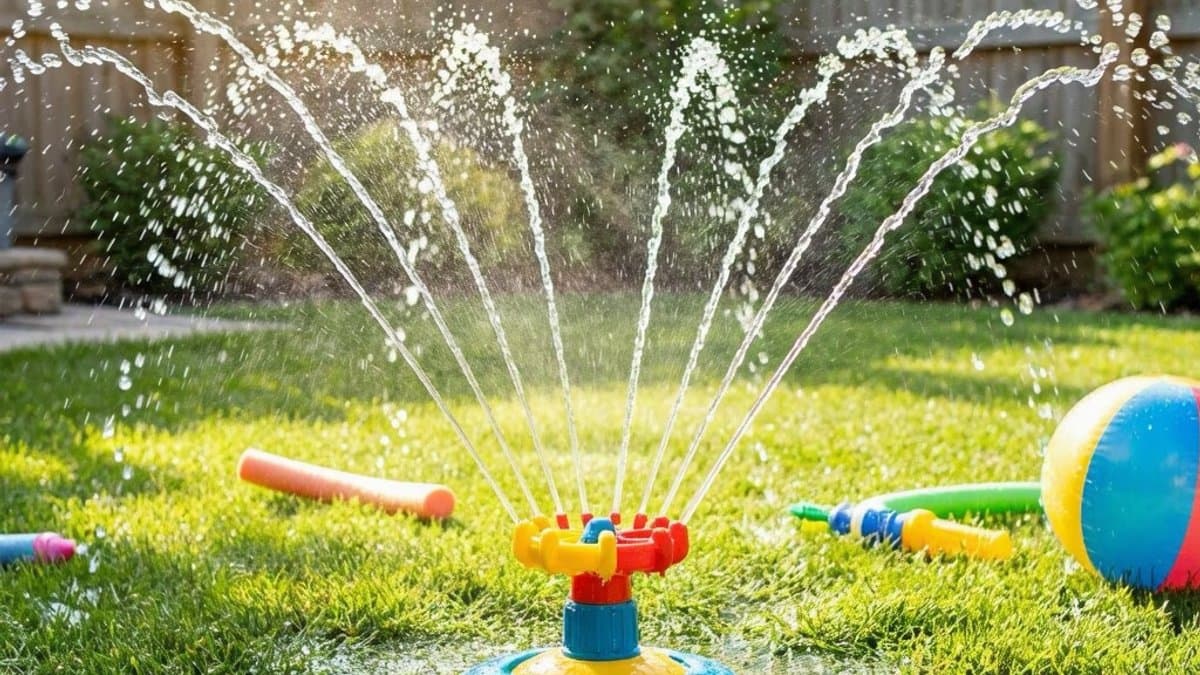
Set up a lawn sprinkler and let children run through it. For older kids, add a challenge — run through without getting hit by the water stream. Adjust the sprinkler pattern to keep it unpredictable. This is the simplest and most universally loved summer activity.
23. Sponge Tag
Players: 3+ | Ages: 4+
Fill a bucket with water and give "it" a large wet sponge. "It" throws the sponge to tag other players. When hit, that player becomes "it" and re-soaks the sponge. This is gentler than water balloon fights and avoids the balloon litter problem.
24. Water Relay
Players: 4+ (2 teams) | Ages: 5+
Place a full bucket of water at one end and an empty bucket at the other for each team. Players use a cup, sponge, or their cupped hands to transfer water from the full bucket to the empty one. The team with the most water transferred in a set time wins.
25. Slip and Slide
Players: 1+ | Ages: 4+
Lay a long tarp or heavy plastic sheeting on a gentle slope. Wet it thoroughly with a hose and add a squirt of dish soap. Children run and slide across the surface. Keep a hose running on the tarp to maintain slipperiness. Always supervise and check for rocks or debris under the tarp before use.
Safety note: Ensure the slide ends on flat, soft ground — never near a fence, wall, or drop-off. Head-first sliding is riskier than feet-first for younger children.
How to Get Kids Playing Outside
If your children are accustomed to screen-based entertainment, transitioning to outdoor free play requires some patience and strategy.
Remove the Default Option
Children will almost always choose screens over outdoor play if both are available. Remove screens from the equation first, then suggest going outside. "Screens are off until dinner. What do you want to do outside?" is more effective than "Stop watching TV and go play." On days when the weather keeps you inside, an indoor obstacle course can burn just as much energy.
Go Outside Yourself
Children follow adults. If you sit on the porch, they will come outside. If you start tossing a ball, someone will join. Your presence outside is the strongest invitation to play.
Set Up an Invitation
Leave a ball, jump rope, or bucket of chalk in the yard before suggesting outdoor play. Children who walk outside and see something ready to use are far more likely to engage than children who walk outside to an empty yard.
Accept Boredom
Children who say "I'm bored" outside are often on the verge of inventing something. Do not rush to fix it. The discomfort of boredom is what drives creativity. Give them 15 minutes before offering suggestions.
Start with One Game
You do not need 25 games today. Pick one game from this list, teach it to your kids, and play it with them the first few times. Once children know a game well, they will teach it to friends and neighbors, and the backyard play culture builds from there.
The best thing about these games is that they belong to children. No adult needs to organize, referee, or structure the experience. Once kids know the rules, they will play, adapt, argue, compromise, and play again — exactly the way childhood is supposed to work.
Frequently Asked Questions
- What are good outdoor games for kids with no equipment?
- Tag (and its many variations like freeze tag, TV tag, blob tag), hide and seek, Red Light Green Light, Mother May I, Simon Says, Duck Duck Goose, capture the flag (use bandanas), sardines, and kickball (with any ball) are all excellent games that require no special equipment.
- What backyard games are good for mixed ages?
- Capture the flag, sardines (reverse hide and seek), obstacle courses, scavenger hunts, and water balloon games work well for mixed ages from 3-12. Give younger players a head start or buddy them with an older child.
- How do I get my kids to play outside more?
- Start by going outside yourself — children follow your lead. Remove the option of screens before suggesting outdoor play. Set up invitations to play (a ball, chalk, a sprinkler) and let them discover activities naturally. Make outdoor play the default, not a reward.
Enjoying this article?
Get more ideas like this delivered to your inbox every week.