How to Make a DIY Busy Board for Toddlers (Step-by-Step Guide)
Build a custom busy board for your toddler with this step-by-step guide — including the best hardware, layout tips, and 25 activity ideas.
By The Slow Childhood
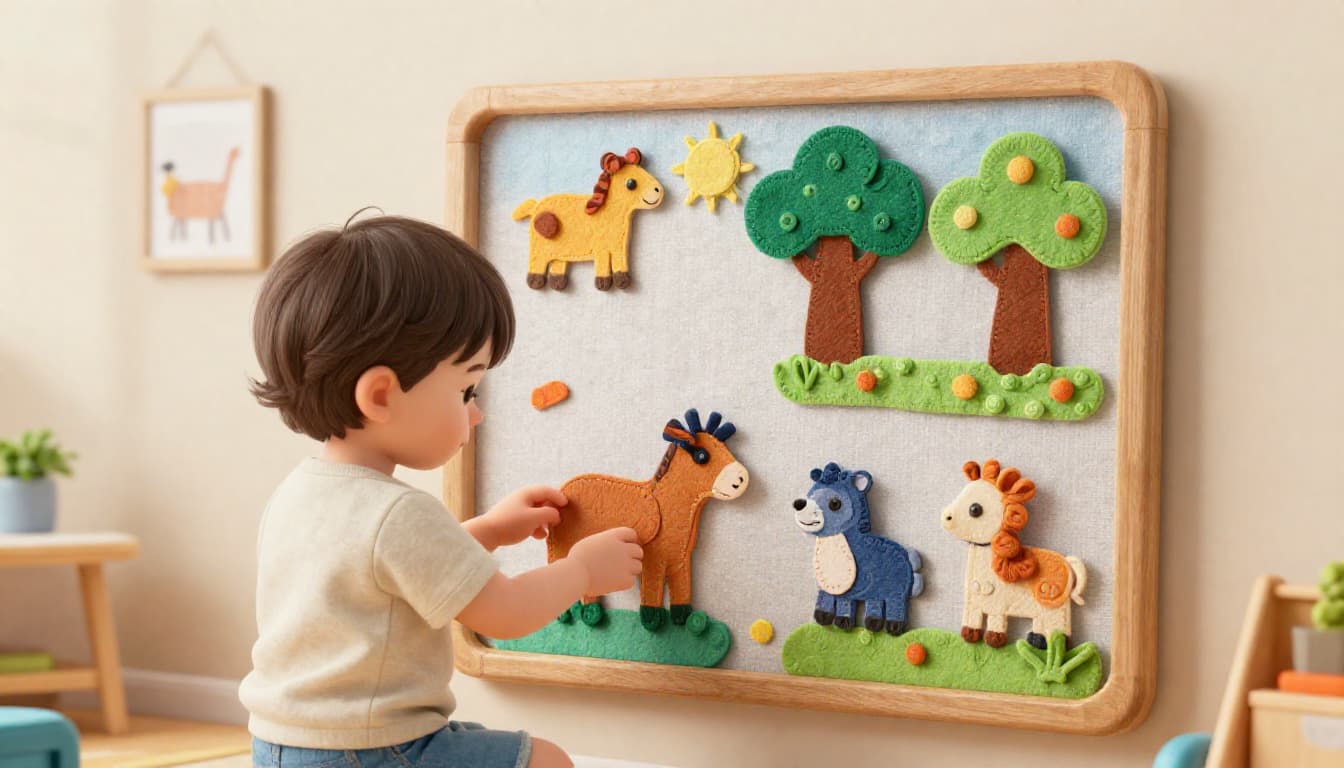
A DIY busy board is a flat board mounted with everyday hardware — latches, switches, locks, wheels, zippers, and knobs — that toddlers can twist, flip, slide, and open to their heart's content. Building one takes about one to two hours and costs between twenty and fifty dollars using a piece of plywood as the base and items sourced from hardware stores, dollar stores, thrift shops, and your own junk drawer. Busy boards develop fine motor skills, hand-eye coordination, problem-solving, and concentration, and they give toddlers a safe, sanctioned way to explore all those fascinating household items they are constantly trying to get their hands on. Below is a complete step-by-step building guide with safety notes, layout tips, and 25 activity ideas to get you started.
What You Need
The Base Board
- Material: A piece of sanded plywood or MDF board, about 1/2 inch thick. Plywood is lighter and easier to drill. MDF has smoother edges but is heavier.
- Size: 2 feet by 2 feet is a good starting size — large enough for 8-12 items but manageable for wall mounting. You can go bigger (2 by 3 feet or 3 by 3 feet) if you have more items and wall space.
- Preparation: Sand all edges smooth. Optionally, paint or stain the board with non-toxic paint before mounting items. White, natural wood, or soft pastel colors work well and make the hardware items stand out visually.
Tools
- Drill with assorted drill bits
- Screwdriver (Phillips and flathead)
- Screws — an assortment of wood screws in different lengths (make sure no screw pokes through the back of the board)
- Strong adhesive (E6000 or construction adhesive) for items that cannot be screwed
- Sandpaper (120-150 grit)
- Level (for wall mounting)
- Wall anchors and heavy-duty screws for mounting the finished board
Safety Supplies
- Thread-locking adhesive (Loctite) for any screws or bolts on the front of the board
- Non-toxic paint
- Rounded corner protectors (optional)
- Battery removal: If using items with batteries, remove the batteries and seal the battery compartment
Step-by-Step Building Guide
Step 1: Gather Your Items
Before you buy anything, walk through your house and look for items to repurpose. Check the junk drawer, the toolbox, the kitchen gadgets drawer, and any old hardware you have stored away. Then visit a hardware store and a dollar store to fill in gaps.
See the 25 activity ideas below for inspiration on what to include.
Step 2: Plan Your Layout
Lay the board flat and arrange all your items on it without attaching anything. This is the most important step — a good layout makes the board both functional and visually appealing.
Layout principles:
- Spread items evenly across the board. Avoid clustering everything in one area.
- Place items that need space to open or swing (like latches and chains) where they will not bump into neighboring items.
- Mix up item types — put a spinning item next to a switching item next to a tactile item. Variety keeps the child exploring.
- Place larger items toward the center and smaller items around the edges.
- Leave a border of at least 1 inch around all edges for mounting hardware.
- Make sure nothing hangs off the edge of the board.
- Think about height — place simpler items at the bottom for younger toddlers and more complex items higher up for older ones.
Step 3: Attach Items Securely
This is where safety matters most. Every item must be attached firmly enough that a determined toddler cannot pull it off.
For items with screw holes (latches, hinges, switches):
- Hold the item in position on the board.
- Mark screw hole locations with a pencil.
- Pre-drill pilot holes slightly smaller than your screws.
- Screw the item in place, making sure screws are tight.
- Check the back of the board — if any screw tips poke through, use shorter screws.
- Apply thread-locking adhesive (Loctite) to the back of each screw to prevent loosening over time.
For items without screw holes (wheels, knobs, decorative items):
- Use strong construction adhesive (E6000 or similar).
- Apply adhesive to the back of the item and press firmly onto the board.
- Let cure for 24 hours before use.
- For extra security, drill a hole through the center of the item and bolt it in place if possible.
For fabric items (zippers, ribbons, felt pieces):
- Screw one end to the board using a small wood screw and washer to prevent tearing.
- Alternatively, use heavy-duty staples covered with a piece of trim.
Step 4: Safety Check
Before mounting the board, do a thorough safety inspection:
- Tug every item firmly. If you can pull it off, a toddler definitely can. Reattach more securely.
- Run your hand across the entire surface. Feel for sharp edges, exposed screw tips, splinters, or rough spots. Sand or file anything that catches.
- Check for small parts. Nothing on the board should be removable and small enough to be a choking hazard (smaller than a toilet paper tube).
- Check the back. No screws should poke through. If any do, file them flat or use shorter screws.
- Remove all batteries from electronic items.
- Test moving parts. Latches, hinges, and spinning items should move freely without pinching fingers.
Step 5: Mount the Board
Wall mounting (recommended):
- Decide on height — the bottom of the board should be at the child's standing waist level so they can reach all items.
- Use a level to mark mounting locations on the wall.
- Use wall anchors rated for the board's weight (typically 10-20 pounds when fully loaded).
- Screw through the board into the wall at all four corners and at least two points along each edge.
- The board should be flush against the wall with no gap behind it.
Freestanding option: If you cannot mount to the wall, attach the board to a stable A-frame stand or lean it against the wall at a slight angle and secure the base so it cannot slide. Freestanding boards must be heavy enough or braced well enough that they cannot tip onto the child.
25 Busy Board Activity Ideas
Latches, Locks, and Closures
- Barrel bolt latch — Slide the bolt left and right to open and close.
- Chain lock — Slide the chain into the track and out again.
- Hook and eye latch — Lift the hook and drop it into the eye.
- Small padlock with key on a chain — Turn the key to open the lock (attach the key with a chain so it cannot be lost).
- Carabiner clip — Squeeze and attach to a fixed ring on the board.
- Cabinet magnetic latch — Push to release the magnetic catch.
- Zipper — Mount a zipper between two pieces of fabric screwed to the board.
- Buckle — Attach a strap buckle (from an old backpack or suitcase strap).
- Snap buttons — Sew large snaps onto fabric strips attached to the board.
- Velcro strips — Mount strips of hook and loop for pulling apart and pressing together.
Switches and Spinners
- Light switch — A standard wall light switch (disconnected from electricity) to flip up and down.
- Dimmer switch — A rotating dimmer dial to turn.
- Door bell buzzer — Mount a battery-free push button (or remove batteries from a functioning one).
- Spinning wheel — A caster wheel or fidget spinner mounted flat to the board.
- Gear set — Two or three interlocking gears that turn together (available from educational toy catalogs).
- Calculator — Mount an old calculator to the board (solar-powered ones need no batteries).
Tactile and Sensory Items
- Door stopper (spring type) — The springy boing sound is endlessly entertaining for toddlers.
- Textured squares — Glue squares of different textures (sandpaper, felt, faux fur, corrugated cardboard, smooth tile) in a row.
- Bead maze — Bend thick wire into a path and thread large wooden beads on it before attaching both ends to the board.
- Brush strip — Mount a short piece of brush strip (the type used for draft-proofing doors). Children love running their fingers through the bristles.
Knobs, Handles, and Moving Parts
- Door knob — A round door knob mounted on a small backplate. The child practices the turning motion.
- Cabinet pulls — Mount 2-3 different styles of cabinet handles and pulls.
- Hinged wooden door — Cut a small square of wood, attach with a hinge, and put a small picture or mirror behind it.
- Pulley with rope — Mount a small pulley and thread a short loop of rope through it. The child pulls one side and the other rises.
- Lacing board — Drill a grid of holes in a small section of the board and provide a shoe lace for lacing practice.
Adapting for Different Ages
10-12 Months
Focus on cause-and-effect items: light switches (flip and see), door stoppers (push and hear the boing), spinning wheels (push and watch), and textured patches (touch and feel). These items require only simple hand movements — pushing, pulling, and patting.
12-24 Months
Add items that require more precise movements: latches that slide, buckles that clip, zippers that pull, knobs that turn, and hooks that lift. This is the peak busy board age — toddlers are driven to practice these skills over and over.
2-3 Years
Introduce complex items: padlocks with keys, combination locks (set to a simple code), lacing boards, gear sets, and pulley systems. At this age, children are solving problems, not just manipulating objects.
Beyond 3 Years
Most children outgrow the busy board between ages 3 and 4 as they move toward more complex practical life activities — real cooking, real tool use, real dressing and undressing. Our guide to Montessori practical life activities by age covers what comes next. When your child loses interest, repurpose the board items in other ways or pass it along.
Troubleshooting Common Issues
Items Keep Coming Loose
Use both screws and adhesive for maximum hold. Pre-drill pilot holes to prevent wood splitting. Use thread-locking adhesive on all screws. Check and re-tighten screws monthly.
The Board Is Too Heavy to Mount
Switch to a thinner plywood (3/8 inch instead of 1/2 inch). Remove a few heavy items. Use multiple mounting points to distribute weight.
My Child Is Not Interested
Start with just 3-5 items on the board and add more gradually. Children can be overwhelmed by too many options. Also consider whether the items match your child's current developmental level — if they are too easy or too difficult, interest drops.
I Cannot Find Cheap Hardware
Check thrift stores, garage sales, and Habitat for Humanity ReStores. Ask friends and family to check their junk drawers. Many of the best busy board items are things people are happy to give away: old locks, unused cabinet hardware, and broken appliances with interesting knobs and switches.
The Value of a Busy Board
A busy board is one of many DIY Montessori materials you can make at home, and it is more than a toy. It is a child's laboratory for understanding how the physical world works. Every latch teaches cause and effect. Every lock teaches problem-solving. Every zipper and buckle builds the fine motor strength and coordination needed for dressing independently. And every minute a toddler spends focused on a busy board is a minute of deep concentration — the foundation of all future learning. Build one this weekend, and watch your toddler work.
Frequently Asked Questions
- What is a busy board for toddlers?
- A busy board (also called an activity board or sensory board) is a board mounted with various objects for toddlers to manipulate — latches, locks, switches, zippers, wheels, door knockers, and other hardware items. It develops fine motor skills, problem-solving, and hand-eye coordination while keeping toddlers engaged.
- What age is best for a busy board?
- Busy boards are ideal for children ages 10 months to 3 years. Younger babies enjoy simple items like light switches and door stoppers. Toddlers 12-24 months love latches, zippers, and spinning objects. Children 2-3 enjoy more complex items like combination locks and lacing activities.
- How much does it cost to make a busy board?
- A DIY busy board typically costs $20-50 depending on materials. Use a piece of plywood ($5-10) as the base, and source hardware items from dollar stores, thrift shops, and your own junk drawer. Many items can be repurposed — old light switches, cabinet latches, door chains, and unused locks.
Enjoying this article?
Get more ideas like this delivered to your inbox every week.