Montessori vs. Waldorf vs. Charlotte Mason: A Homeschool Method Comparison
A side-by-side comparison of Montessori, Waldorf, and Charlotte Mason — approach, materials, daily rhythm, and who each method suits — plus starter books and supplies for each.
By The Slow Childhood
Choosing a homeschool philosophy can feel like choosing a religion: each camp has passionate believers, beautiful Instagram accounts, and a stack of books insisting their way is the way. Three of the most enduring child-centered approaches — Montessori, Waldorf, and Charlotte Mason — all reject the worksheet-and-test model of conventional school, all respect children deeply, and all produce capable, curious learners. Yet underneath the shared values, they are profoundly different in how they treat structure, materials, imagination, and the timing of reading and math.
This guide puts the three methods side by side so you can see exactly how they differ in practice — not just in theory. I will compare their core philosophy, the materials each requires, what a daily rhythm actually looks like, the kind of child and parent each suits best, and the starter books and supplies that get you going. By the end you will know which one fits your family — or, more likely, how to borrow the best of all three. If you are brand new to all of this, start with our beginner's guide to homeschooling first, then come back here to choose a philosophy.
The Three Methods at a Glance
Before we dig into each one, here is the big-picture comparison. Read it as a map, not a verdict — every cell hides nuance we will unpack below.
| Dimension | Montessori | Waldorf | Charlotte Mason |
|---|---|---|---|
| Founder | Maria Montessori (physician, 1907) | Rudolf Steiner (philosopher, 1919) | Charlotte Mason (educator, 1890s) |
| Core idea | "Follow the child" through self-directed work | Educate head, heart, and hands in developmental stages | "Children are born persons" fed on living ideas |
| Reading starts | Early (often 3-5, child-led) | Late (formal reading at 6-7) | Around 5-6, gently |
| Materials | Specific, self-correcting manipulatives | Natural, open-ended, intentionally simple | Living books, nature journal, minimal supplies |
| Role of fantasy | Reality-based early; fantasy later | Central — fairy tales, myth, imagination | Welcomed alongside real books and biographies |
| Daily structure | Long uninterrupted "work cycle" | Predictable rhythm with wet-on-wet flow | Short, varied lessons; free afternoons |
| Screen stance | Minimal/none in early years | Strongly discouraged | Minimal; nature over screens |
| Cost to start | Moderate to high (materials) | Moderate (quality toys, art supplies) | Low (library card + journal) |
| Best known for | Independence and concentration | Wonder, artistry, and unhurried childhood | Book love and nature connection |
All three pair naturally with a slow, screen-free family culture — which is exactly why parents drawn to one are often drawn to all three.
Montessori: Independence Through the Prepared Environment
Maria Montessori was Italy's first female physician, and her method carries a doctor's faith in observation. She watched children intently and concluded that, given the right environment and freedom to choose, children naturally gravitate toward purposeful work and deep concentration.
The Montessori Approach
The heart of Montessori is the prepared environment and the work cycle. The room is arranged so that everything is child-sized, accessible, and ordered. Materials sit on low open shelves, each with a clear purpose, arranged from simple to complex. The child chooses what to work on, works with it for as long as they like, and returns it to the shelf when finished. Lessons are presented one-on-one, then the child practices independently.
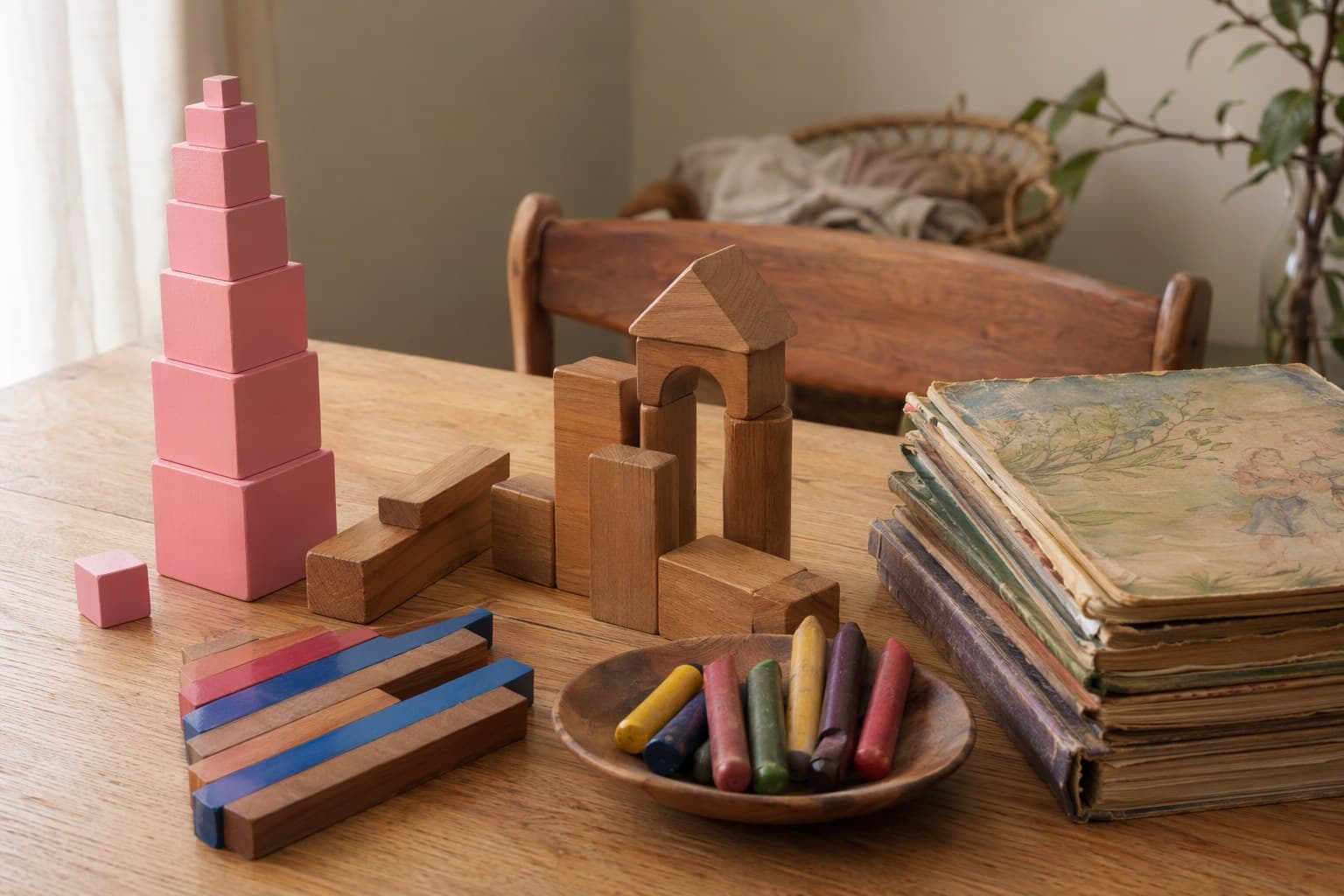
Crucially, Montessori materials are self-correcting. The pink tower only stacks neatly one way; the knobbed cylinders only fit their matching holes. The material itself shows the child the error, so they learn without an adult hovering and correcting. This builds independence and intrinsic motivation rather than reliance on praise.
In the early years, Montessori favors reality over fantasy. A toddler learns to pour water, button a shirt, and slice a banana through practical life activities before they ever touch a fairy tale. These tasks build the coordination, order, and concentration that later academic work depends on. Our guide to Montessori practical life by age maps out what to introduce when.
Montessori Materials
Authentic Montessori materials are specific and not cheap, but they last for years and serve multiple children. The classic early-childhood set includes the Montessori pink tower and broad stair, sandpaper letters for tactile phonics, and wooden number rods for early math. If the cost feels steep, you can make a surprising amount yourself — see our roundup of DIY Montessori materials you can make at home.
A Montessori Day
A Montessori day is built around a long, uninterrupted work cycle — ideally two to three hours in the morning where the child moves freely between activities they have chosen. The parent observes, presents new materials when the child is ready, and otherwise stays out of the way. Order and routine matter enormously: the same shelves, the same expectations, the same gentle rhythm every day.
Montessori is best for children who crave independence and order, parents willing to learn the material sequences, and families who find that structure-plus-freedom is the sweet spot. It is not ideal if you want a fully scripted open-and-go program, or if the upfront cost of materials is a barrier.
Waldorf: Protecting the Dreamy Years
Rudolf Steiner founded the first Waldorf school in 1919 for the children of factory workers in Stuttgart. His philosophy, anthroposophy, sees childhood unfolding in roughly seven-year stages, and Waldorf education is built to match the child's developmental phase rather than rush ahead of it.
The Waldorf Approach
If Montessori prizes purposeful work, Waldorf prizes imagination and unhurried development. Formal academics — reading, writing, structured math — are deliberately delayed until around age six or seven, when Waldorf believes the child is developmentally ready. The early years are devoted to play, story, song, movement, and practical activities like baking and gardening.
Fantasy is central, not avoided. Fairy tales, myths, and seasonal festivals fill the early years. The teacher tells stories rather than reads them, drawing the child into a world of imagination. Beauty matters: natural materials, soft colors, handmade everything. Even the famous Waldorf "wet-on-wet" watercolor painting is about experiencing color and mood, not producing a finished picture.
Waldorf also leans hard into rhythm. Days, weeks, and seasons follow a predictable, comforting flow. This breathing in-and-out between active and quiet, between focused and free, is meant to give the child security. A consistent daily homeschool schedule is essential to making a Waldorf-inspired home work.
Waldorf Materials
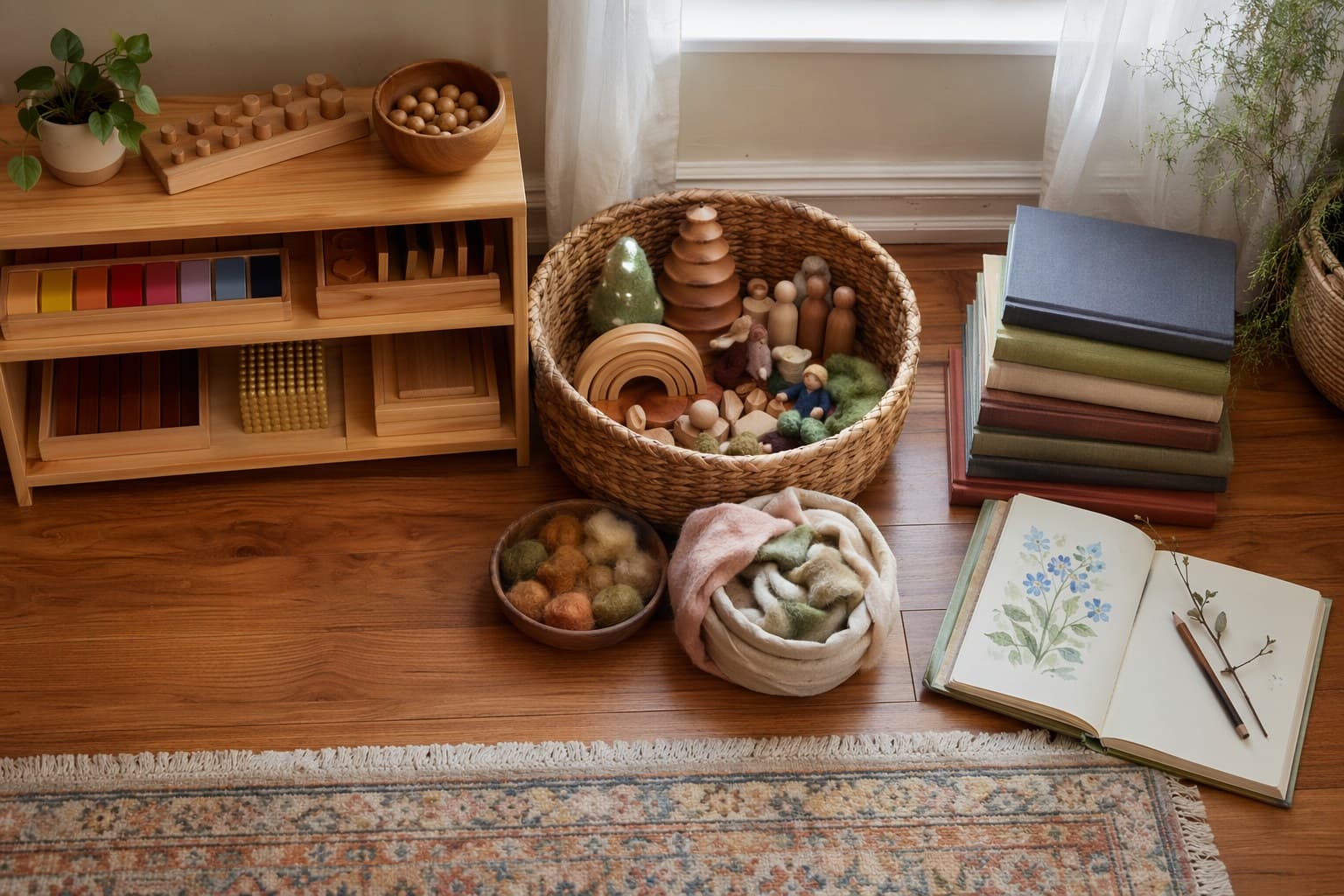
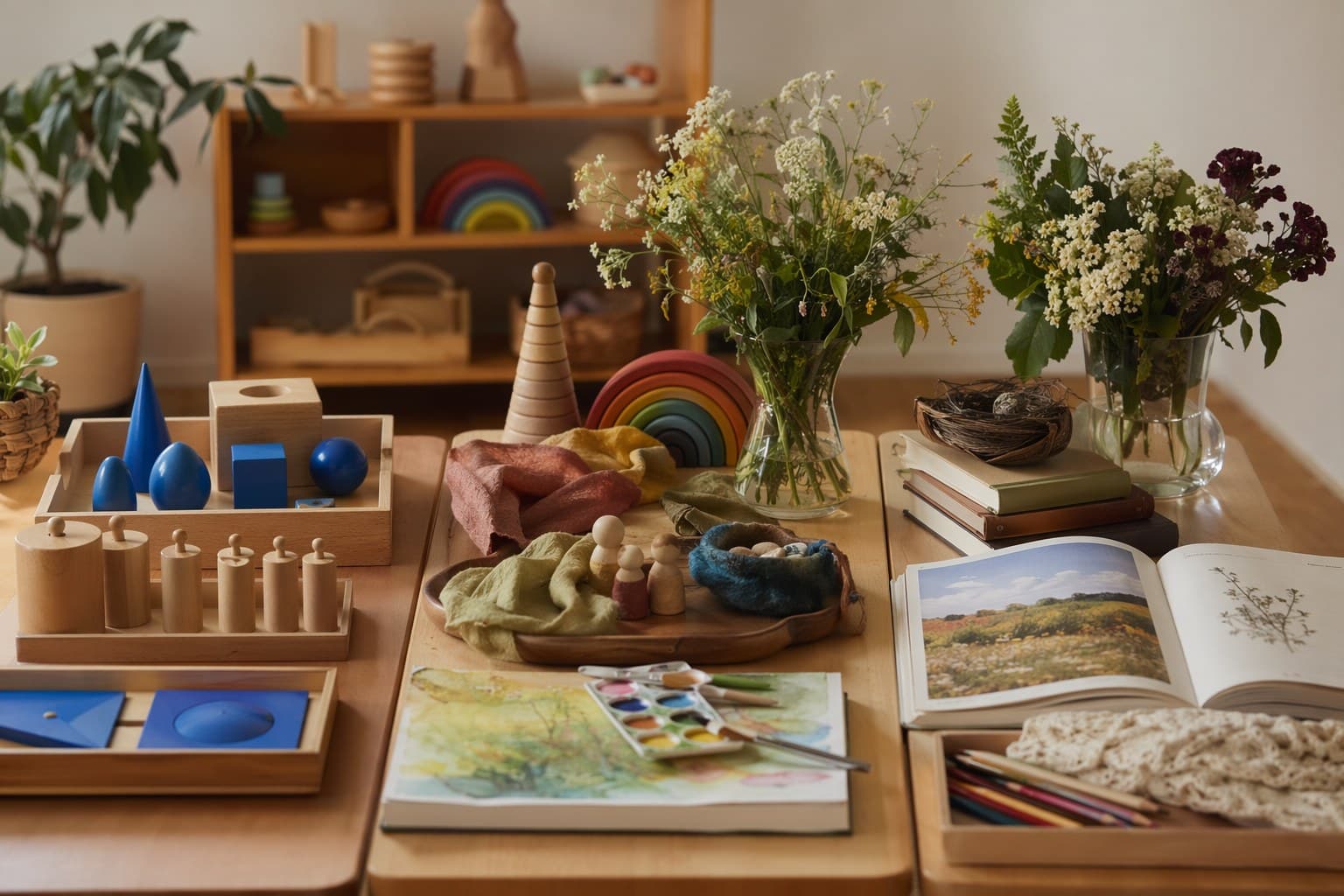
Waldorf materials are intentionally simple and open-ended, so the child supplies the imagination. Think natural wooden toys for toddlers rather than light-up plastic. A starter kit might include Waldorf wooden building blocks, a set of Stockmar beeswax block crayons, Stockmar watercolor paints for wet-on-wet painting, and a basket of wool felt and yarn for handcrafts. Handwork is a pillar of the method; our guide to Waldorf handwork projects for kids shows how to begin with simple finger-knitting and felting.
A Waldorf Day
A Waldorf morning often opens with a circle of songs and verses, moves into a main lesson taught in a multi-week "block" (one subject explored deeply for weeks at a time), then flows into handcrafts, baking, or outdoor play. There is no rushing, no testing, no screens. The afternoon is for free, imaginative play and time in nature.
Waldorf is best for families who want to protect early childhood from academic pressure, who value art and handcraft, and who are willing to model the rhythms and skills themselves. It is a harder fit if you are anxious about delayed reading, or if you want a tech-forward, fast-paced curriculum.
Charlotte Mason: A Feast of Living Ideas
Charlotte Mason was a British educator who insisted that "children are born persons" — whole, thinking beings deserving of a rich, broad education rather than dry facts. Her method is arguably the most accessible of the three because its primary materials are books and the outdoors.
The Charlotte Mason Approach
The cornerstone is living books — well-written works by passionate single authors that make a subject come alive, in contrast to committee-written textbooks. Instead of comprehension worksheets, Mason used narration: after a single reading, the child "tells back" what they heard in their own words. It is deceptively simple and remarkably effective at building attention, vocabulary, and genuine understanding.
Lessons are short — 15 to 20 minutes per subject for young children — because Mason understood that attention is a muscle best trained in brief, focused bursts. The afternoons are left free for play, handicrafts, and rest. And nature study is non-negotiable: children spend time outdoors daily and keep a nature journal throughout their education.
Other signature practices include copywork (carefully copying excellent prose to absorb grammar and spelling), picture study (one artist per term), and composer study (one composer per term). For the full breakdown, see our dedicated Charlotte Mason curriculum guide.
Charlotte Mason Materials
This is where Charlotte Mason wins on cost: your main investments are a library card and a good nature journal. Beyond that, a few staples help — a quality nature journal and sketchbook, a set of Prismacolor colored pencils for journaling, and a classic living book like Paddle-to-the-Sea by Holling C. Holling to read aloud. The free Ambleside Online curriculum supplies complete book lists for every year.
A Charlotte Mason Day
Mornings hold short, varied lessons: math, reading, a living-book read-aloud with narration, copywork, and a brief picture or composer study a few times a week. By late morning the structured work is done, and the rest of the day belongs to outdoor time, nature journaling, free play, and following the child's own interests.
Charlotte Mason is best for families who love reading aloud, value nature, and want short school days with generous free time. It is less ideal if your child genuinely prefers workbooks, or if you need a rigidly scripted, decision-free program.
Head-to-Head: Where the Methods Diverge Most
The glance table covered the basics. Here are the three differences that matter most in daily life.
When Academics Begin
This is the sharpest divide. Montessori introduces letters and numbers early through sensorial materials, often by age three or four, following the child's readiness. Charlotte Mason begins gentle reading and math around five or six. Waldorf deliberately waits until six or seven, prioritizing play and imagination first. If you have an early reader straining to decode words at four, Waldorf will frustrate you; if you have a dreamy child who is not interested in letters at five, Waldorf will feel like a relief. Whichever camp you land in, you will eventually need a systematic reading plan — our phonics program comparison covers the options that pair with each method.
The Role of Fantasy
Waldorf swims in fantasy — fairy tales, gnomes, seasonal festivals. Montessori keeps the early years reality-based, believing young children need to understand the real world before the imaginary one, then welcomes fantasy after about age six. Charlotte Mason sits comfortably in the middle, embracing both rich storybooks and real biographies and histories.
Structure Versus Freedom
All three give children freedom, but they structure it differently. Montessori offers freedom within a carefully prepared environment and a defined material sequence. Charlotte Mason offers short structured lessons followed by wide-open afternoons. Waldorf offers a strong rhythmic container with imaginative freedom inside it. None is "do whatever you want" — and none is a worksheet factory.
How to Choose (and Why You Might Blend)
Here is the honest truth most method purists will not tell you: very few homeschools stay 100 percent loyal to one philosophy. Real children do not read the manuals.
Start by observing your actual child. Does she crave order, repetition, and doing things "by herself"? Montessori will resonate. Does he live in an imaginative world and wilt under early academic pressure? Lean Waldorf. Does she light up when you read aloud and beg for "one more chapter"? Charlotte Mason is calling.
Then observe yourself. Charlotte Mason asks the least specialized preparation and the lowest budget. Montessori asks you to learn material sequences and invest in (or make) manipulatives. Waldorf asks you to learn songs, stories, and handcrafts and to model an unhurried rhythm.
A wildly common and effective blend looks like this:
- Montessori for early practical life and hands-on math materials
- Waldorf for open-ended toys, seasonal handcrafts, and protecting imaginative play
- Charlotte Mason for the academic spine of living books, narration, and daily nature study
This eclectic approach lets you match method to subject and to the child in front of you. If you are juggling siblings at different stages, our guide to homeschooling multiple ages at once shows how a blended rhythm keeps everyone learning together.

Frequently Asked Questions
Is one method more academically rigorous than the others? Not in the way standardized testing measures, and that is by design. All three produce strong learners, but they sequence content differently. Montessori children often read and compute early; Waldorf children catch up rapidly once formal academics begin around seven; Charlotte Mason children typically develop unusually strong reading comprehension and narration skills. Rigor here means depth of understanding, not worksheet volume.
Do these methods work for kids with learning differences? Often, yes — the individualized, low-pressure nature of all three can suit children who struggle in conventional classrooms. The hands-on, multi-sensory Montessori materials and the short Charlotte Mason lessons are especially adaptable. That said, some children benefit from more explicit, structured instruction in specific areas; see our guide to curriculum for ADHD and learning differences for targeted options you can layer in.
Which method is cheapest to run long-term? Charlotte Mason, comfortably. Its core resources are library books, a nature journal, and the outdoors, with an excellent free curriculum available online. Montessori has the highest upfront cost because of specialized materials, though you can offset that with DIY versions. Waldorf falls in between — quality natural toys and art supplies add up, but they last for years and across siblings.
The Bottom Line
Montessori, Waldorf, and Charlotte Mason are not rival products to pick between like brands of cereal. They are three deeply considered answers to the same question: how do we educate a child while honoring who they are? Montessori answers with purposeful independence, Waldorf with protected imagination, and Charlotte Mason with a feast of living ideas and time in nature.
If you remember nothing else, remember this: the best method is the one you will actually sustain with the child you actually have. Pick the philosophy that makes you exhale, borrow freely from the other two, and trust that a child surrounded by good books, real materials, fresh air, and an attentive parent is going to be just fine.
That is the slow, unhurried childhood all three of these wise educators were really after.
Frequently Asked Questions
- What is the main difference between Montessori, Waldorf, and Charlotte Mason?
- Montessori centers on self-directed work with structured, self-correcting materials in a prepared environment. Waldorf delays formal academics, protects imaginative play, and teaches through art, story, and natural rhythms. Charlotte Mason uses living books, narration, short lessons, and daily nature study. All three reject worksheets and standardized testing, but they differ sharply in how much structure they give the child and when they introduce reading and math.
- Which method is easiest for a beginner homeschool parent?
- Charlotte Mason is usually the easiest to start because it relies on library books, narration, and outdoor time rather than expensive specialized materials. The free Ambleside Online curriculum gives you a complete plan. Montessori has a steeper learning curve because the materials must be presented in a specific sequence, and Waldorf asks the parent to learn handcrafts, songs, and seasonal rhythms before teaching them.
- Can you combine Montessori, Waldorf, and Charlotte Mason in one homeschool?
- Yes, and most veteran homeschoolers eventually do. A common blend uses Montessori practical-life and math materials in the early years, Waldorf-style open-ended toys and seasonal handcrafts for play, and Charlotte Mason living books, narration, and nature journaling for the academic spine. The key is to pick the practices that fit your child rather than following any single method rigidly.
Enjoying this article?
Get more ideas like this delivered to your inbox every week.