Nature-Based Learning Activities for Every Subject
How to teach every subject through nature — from outdoor math games and science walks to nature journaling and geography through exploration.
By The Slow Childhood
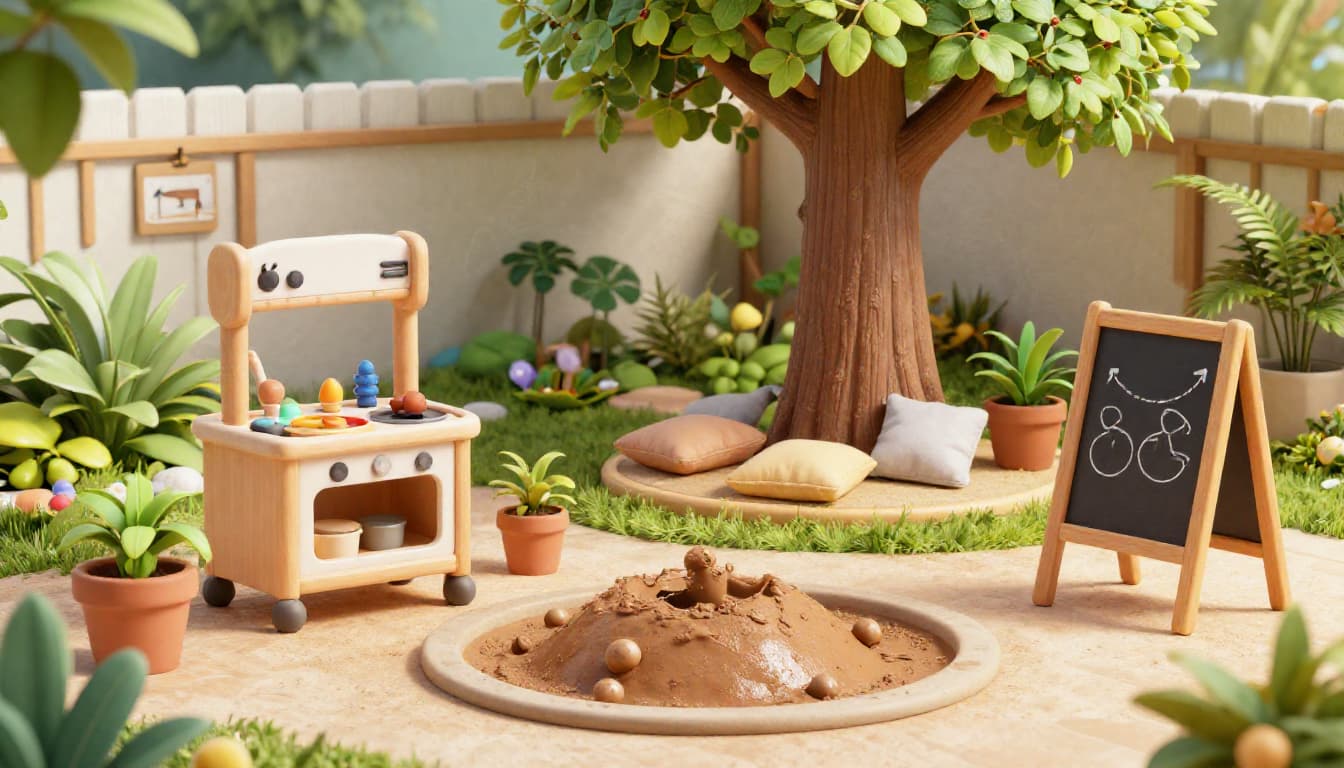
Nature is the oldest classroom. Long before textbooks, worksheets, and screens, children learned by watching rivers, counting seeds, tracking animals, and listening to the wind. Charlotte Mason, the 19th-century British educator whose ideas continue to shape thoughtful homeschooling, believed that children should spend hours outdoors every day and that nature itself was one of the most powerful teachers available. Modern research supports her conviction — studies consistently show that outdoor learning improves attention, reduces stress, deepens understanding of scientific concepts, and increases motivation to learn. The good news is that you do not need a nature preserve or a farm to teach through nature. A backyard, a city park, a patch of sidewalk weeds, or even a window box will do. This guide organizes nature-based learning activities by subject so you can take almost any lesson and move it outside.
Why Nature Is the Best Classroom
The Charlotte Mason Foundation
Charlotte Mason placed nature at the center of education for young children. She argued that direct contact with the natural world — not pictures of nature in books or videos on screens — develops a child's powers of observation, feeds their sense of wonder, and provides a concrete foundation for later abstract learning. In her schools, children spent entire mornings outdoors. They sketched wildflowers, watched birds, tracked the seasons, and kept detailed nature notebooks that served as personal field guides.
You do not need to follow Charlotte Mason's methods exactly to benefit from her core insight: children who spend regular time outdoors, paying attention to the living world, learn more deeply and retain more than children who study the same topics only from books.
What the Research Shows
Contemporary studies reinforce what Mason observed over a century ago. Children who learn outdoors show improved concentration, better working memory, and lower cortisol levels compared to indoor learning. Green spaces reduce symptoms of attention difficulties. Hands-on outdoor activities lead to stronger retention of science concepts than textbook-based instruction. Even brief periods of unstructured time in nature — as little as twenty minutes — improve cognitive performance on subsequent tasks.
You do not need to turn every lesson into an outdoor expedition. Even one or two nature-based activities per week can shift the tone of your homeschool and deepen your children's connection to what they are learning.
Math in Nature
Mathematics is not an indoor subject trapped in a workbook. It is the language of the natural world — patterns, measurements, quantities, shapes, symmetry, and change are everywhere outdoors. Moving math outside gives children concrete, tangible experiences with concepts that can feel abstract on paper.
Activities
Measure everything. Bring a tape measure, a ruler, and a piece of string on your next walk. Measure the circumference of tree trunks. Estimate the height of a tree by measuring its shadow and your child's shadow, then using the ratio. Measure the length of leaves, the width of a puddle, the distance between fence posts. For children working on units of measurement, there is no better practice than measuring real objects in a real environment.
Count and tally species. Choose a section of the yard or park and count how many different species of plants, insects, or birds you can find in a set amount of time. Record the numbers in a tally chart. Older children can create bar graphs or pie charts of their findings. This integrates counting, data collection, and graphing in a single nature walk.
Find symmetry in leaves and flowers. Collect several leaves and flowers. Fold each one in half along the center line and discuss whether the two halves are symmetrical. Sketch the line of symmetry. Look for radial symmetry in flowers (like daisies) versus bilateral symmetry in leaves (like maple leaves). This is geometry that children can hold in their hands.
Graph the weather. Track daily temperature, cloud cover, and precipitation for a month. Record the data in a chart and graph it. Calculate the average temperature for the week. Find the range between the highest and lowest readings. Compare this month's data to last month's. Weather tracking is a long-term math project that happens naturally when you step outside each morning. If you are looking for more ways to bring hands-on math into your routine, our collection of homeschool math games and activities includes many ideas that pair well with outdoor learning.
Estimate distances. Stand at one end of a park and estimate how many steps it takes to reach a tree, a bench, or the far fence. Walk and count. How close was the estimate? Repeat with different landmarks. For older children, introduce estimation of longer distances — how far is it across the field in meters? Pace it off and compare. Estimation is a practical math skill that is best developed through repeated real-world practice.
Science in Nature
Science outdoors is not a separate subject — it is simply paying attention with curiosity and recording what you notice. The natural world is an endless laboratory, and children are natural scientists when given the time and encouragement to observe.
Activities
Conduct nature walks with focused observation. Choose a different focus for each walk — this week we are looking at insects, next week we are studying bark patterns, the week after we are listening for bird calls. Carry a magnifying glass and a notebook. Stop frequently. Look closely. Ask questions: What do you notice? Why do you think this is happening? What would happen if we came back in a month? These walks develop the scientific habit of observation, which is the foundation of all further study.
Track plant life cycles. Choose a plant in your yard or a nearby park — a flowering plant, a vegetable in the garden, or a tree — and observe it weekly throughout a season. Sketch it at each stage. Measure its growth. Record when buds appear, when flowers open, when seeds form. Over weeks, children witness the full cycle of growth, reproduction, and dormancy. If you have a garden, this happens naturally as part of gardening with kids.
Study a pond or stream. Visit a pond, creek, or even a large puddle after rain. Observe what lives there — water insects, tadpoles, algae, snails, water striders. Bring a clear container to scoop up a sample and examine it closely. Discuss the food web: what eats what? How does water quality affect what lives there? Return the sample when you are done. A single pond visit can generate weeks of follow-up research and journaling.
Identify rocks and minerals. Collect interesting rocks on your walks. At home, test their properties — do they scratch glass? Do they fizz with vinegar? Are they magnetic? Are they smooth or rough, heavy or light? Use a simple rock identification guide to classify them as igneous, sedimentary, or metamorphic. Build a rock collection with labels. This introduces geology through hands-on investigation.
Watch the weather with intention. Go beyond simply checking the forecast. Observe cloud types and learn their names — cumulus, cirrus, stratus, cumulonimbus. Track wind direction using a homemade wind vane or a wet finger held up to the breeze. Predict whether it will rain based on cloud patterns and check your prediction. Weather is real-time, ever-changing science happening directly overhead.
Language Arts in Nature
Reading, writing, and oral language all thrive outdoors. Nature provides an endless supply of subjects to write about, vocabulary to learn, and inspiration for storytelling and poetry. Moving language arts outside often frees up children who feel stiff or resistant when faced with a blank page at the kitchen table.
Activities
Keep a nature journal. Nature journaling is one of the most powerful cross-curricular activities available to homeschoolers. Children draw what they observe, write descriptions, label parts, record dates and weather, and build a personal field guide over time. The writing is purposeful and connected to direct experience, which makes it more meaningful than most writing prompts. We have a complete guide to nature journal ideas for kids with prompts for every season and tips for all ages.
Tell stories outdoors. Sit under a tree and take turns telling stories inspired by what you see. What if that squirrel could talk — what would it say? Imagine you lived in a hollow tree — describe your home. What happened in this park a hundred years ago? Oral storytelling builds narrative skills, vocabulary, and confidence. Young children can dictate stories while a parent writes them down.
Write poetry inspired by nature. Nature and poetry have been connected for centuries, and with good reason — the natural world is full of sensory detail, rhythm, and metaphor. Start simple: write a haiku (5-7-5 syllables) about something you see. Describe a single natural object using all five senses. Write a list poem: "I saw... I heard... I smelled... I touched... I tasted..." Older children can study nature poems by Mary Oliver, Robert Frost, or Emily Dickinson and write their own in response.
Build vocabulary from field guides. Spend time with a field guide for your region — birds, wildflowers, trees, insects, or mushrooms. Look up what you find on your walks. Learn the real names: not just "yellow flower" but "black-eyed Susan." Not just "brown bird" but "song sparrow." Scientific and common names build vocabulary in a context that is memorable because it is personal. A child who learns the word "deciduous" while watching their favorite tree drop its leaves will never forget what it means.
Write letters about adventures. After a nature walk, hike, or outdoor exploration, have your child write a letter to a grandparent, pen pal, or friend describing what they saw, did, and discovered. Letter writing is a form of composition that has a real audience and purpose, which motivates children far more than writing for a grade.
History and Geography in Nature
The land around you holds layers of history and geography waiting to be explored. You do not need to travel to historic sites — though that is wonderful when possible — because every place has a story and every landscape is a geography lesson.
Activities
Take local history walks. Research the history of your town, neighborhood, or region and walk through it. Who lived on this land before your town was built? What was this area used for a hundred years ago — farmland, forest, marshland? Are there historical markers, old buildings, or cemeteries nearby? Walk past them and discuss what life was like. Local history makes the past tangible in ways that textbook narratives cannot.
Make maps. Map-making is one of the most engaging geography activities for children of all ages. Start with your yard — draw a bird's-eye view showing the house, trees, garden, and fence. Progress to your street, your neighborhood, your walking route to the park. Older children can add compass roses, scale bars, and legends. Map-making teaches spatial thinking, direction, scale, and the relationship between a real place and its representation.
Study land features in person. Hills, valleys, rivers, ridges, plains, and coastlines are not just vocabulary words — they are the ground under your feet. When you walk across a hill, discuss why it is there. When you cross a creek, talk about where the water comes from and where it goes. When you see a flat open area, consider why it is flat. Geography studied in person, with your feet on the terrain, makes far more sense than geography studied on a map alone. If you are looking for ways to deepen this subject at home, our guide to the best geography curriculum for elementary students includes options that pair well with outdoor exploration.
Learn about indigenous plants and their uses. Research which plants in your area are native and how indigenous peoples used them — for food, medicine, fiber, or dye. This connects botany, history, and cultural studies in a walk through your own neighborhood. Many local nature centers and botanical gardens offer guides to native plants and their historical significance.
Create a timeline of seasons. Throughout the year, photograph or sketch the same tree, garden bed, or landscape view once a month. Arrange the images in chronological order to create a visual timeline of seasonal change. This teaches both the concept of timelines (a history skill) and the patterns of seasonal cycles (a science concept). Over multiple years, children can compare timelines and notice patterns.
Art in Nature
The natural world has inspired artists for as long as humans have made art. Taking art outside changes the experience — the light is different, the materials are free, the subjects are alive, and the results are often surprising.
Activities
Sketch from life. Sit outdoors with a sketchbook and draw what you see — a single flower, a gnarled tree trunk, a bird at the feeder, the view from a hilltop. Drawing from life teaches observation in a way that drawing from photographs cannot, because real objects have depth, texture, light, and movement that a flat image lacks. Start with pencil. Add watercolor pencils or a small paint set as confidence grows.
Make leaf and flower prints. Collect leaves with interesting shapes and prominent veins. Paint the veined side with acrylic or tempera paint and press it onto paper. Lift to reveal the print. Layer multiple colors and leaf shapes. Flower petals, fern fronds, and grasses also make beautiful prints. This connects well with the many other nature art projects that use found materials as both subject and medium.
Create land art. Land art is sculpture made from natural materials arranged outdoors — think Andy Goldsworthy's spirals of leaves, arches of stones, and lines of sticks. Children can create mandalas from petals and pebbles, spirals from pinecones and acorns, or frames from sticks around a beautiful patch of moss. Land art is temporary by nature, so photograph it and enjoy the impermanence. This teaches composition, pattern, and the beauty of working with what is available.
Experiment with natural dyes. Gather berries, onion skins, turmeric, red cabbage, walnut hulls, or other pigment-rich plant materials. Simmer them in water to extract color (with adult supervision). Dip paper, fabric scraps, or yarn into the dye bath. Observe the colors produced — they are often different from what you expect. Natural dyeing connects art, chemistry, and botany in a single afternoon project.
Photograph the natural world. Hand your child a camera (a phone camera works fine) and let them photograph what catches their eye outdoors. Reviewing the photographs later reveals what the child notices and values. Print favorites and create a nature photo journal or gallery wall. Photography teaches composition, light, perspective, and observation — all core visual art skills — without any drawing anxiety.
Music in Nature
Music and nature share a deep connection. The rhythms, patterns, and sounds of the outdoor world are the original music, and bringing musical awareness into nature time enriches both experiences.
Activities
Identify bird songs. Learning to recognize local birds by their songs is a skill that transforms every walk into a concert. Start with two or three common species — robin, cardinal, chickadee, mourning dove — and learn their calls using a field guide or a bird identification app. Once children can recognize a few calls, they naturally start listening for more. Birdsong identification trains the ear the same way a music class does — through careful, repeated listening.
Listen for rhythms in nature. Sit quietly outdoors and listen. A woodpecker's tapping has a rhythm. Rain on leaves has a pattern. Wind through branches creates a kind of melody. Ask your child to clap along with a natural rhythm they hear, or to describe the "music" of a particular spot. This builds awareness of tempo, rhythm, and dynamics.
Make instruments from natural materials. Fill a dried gourd with seeds to make a shaker. Stretch a rubber band across a hollow log for a simple string instrument. Tap sticks together for rhythm sticks. Fill glass jars with different levels of water and tap them for a scale. Blow across the top of an acorn cap for a whistle. Building instruments from found and natural materials connects music, engineering, and creativity.
Compose a nature soundscape. After a listening walk, have your child recreate the sounds they heard using their voice, body percussion, and homemade instruments. Layer the sounds — wind, birds, footsteps on gravel, a distant airplane — into a composition. Record it. This is an accessible entry into musical composition that requires no formal training.
Sing outdoors. Singing sounds and feels different outside than inside. There is no echo, the space is vast, and the acoustic experience changes with the environment. Sing folk songs on a hike. Sing a lullaby in the garden. Make up songs about what you see. The outdoors removes the self-consciousness that often accompanies singing indoors, especially for older children.
Seasonal Considerations
Nature-based learning looks different in each season, and that is part of its beauty. Rather than teaching the same lessons year-round, let the season guide your focus.
Spring
Spring is ideal for plant life cycle studies, garden planning and planting, bird observation (migration and nesting season), insect emergence, weather tracking (dramatic changes day to day), and poetry inspired by renewal and growth.
Summer
Summer offers long days for extended outdoor time, pond and stream study, insect observation at peak diversity, wildflower identification and pressing, nature journaling in comfortable weather, and land art with abundant materials.
Fall
Fall is the richest season for nature-based learning. Leaf collection and identification, seed dispersal studies, harvest math (weighing pumpkins, counting apples), weather pattern changes, bird migration tracking, and preparation-for-winter animal behavior all provide compelling subject matter.
Winter
Winter is quieter but no less valuable. Animal tracking in snow or mud, bare-tree branching pattern studies, winter bird identification, weather and temperature graphing, constellation observation (earlier darkness, clearer skies), and reflective writing and indoor journaling based on fall observations all work well.
Minimal Supplies Needed
One of the greatest advantages of nature-based learning is how little you need to buy. Here is a basic outdoor learning kit that costs very little and covers every subject:
- A nature journal and pencils. For recording observations, sketching, writing, and data collection across all subjects.
- A magnifying glass. Transforms any walk into a science investigation.
- A tape measure or ruler. For math activities involving measurement and estimation.
- A field guide for your region. One good guide to local birds, wildflowers, or trees supports science, vocabulary, and geography.
- A clipboard. Makes any outdoor spot a writing and drawing surface.
- A small bag for collecting. A canvas tote or paper bag for gathering leaves, rocks, seeds, and other specimens.
- A camera. A phone camera works perfectly for documentation.
That is it. You do not need a curriculum, a kit, or special equipment. The natural world provides the materials, the lessons, and the motivation.
How to Document Nature-Based Learning for Records
If your state or country requires homeschool documentation, nature-based learning can sometimes feel difficult to record because it does not produce worksheets. Here are practical ways to document what your children are learning outdoors.
The Nature Journal as a Portfolio
A well-kept nature journal is itself a portfolio of learning. It contains evidence of writing, drawing, scientific observation, data collection, and research. Date every entry. Periodically photograph journal pages for your digital records.
Subject-Coded Notes
After each nature-based activity, jot a quick note in your planner or log, coding it by subject: "Nature walk — identified 5 tree species (science, vocabulary). Measured tree circumference (math). Sketched oak bark (art). Discussed land use history of our neighborhood (history)." A single outdoor session often covers multiple subjects.
Photograph Everything
Take a photograph of your child measuring a tree, sketching in their journal, examining a rock, or pointing to a bird. Photographs are powerful documentation that shows engagement and learning in action. Organize photos by month in a digital folder.
Lists and Logs
Keep simple running lists: birds identified this year, plants in our garden, rocks in our collection, nature walks completed, books read about nature topics. These lists accumulate into an impressive record of learning over the course of a year.
Getting Started This Week
You do not need to overhaul your homeschool to begin teaching through nature. Start with one change.
This week: Take one lesson that you normally do indoors and move it outside. Read your history chapter under a tree. Do math practice on the porch. Draw a picture in the backyard instead of at the kitchen table. Just changing the setting can shift the energy of the entire day.
Next week: Add one dedicated nature activity. Take a focused observation walk and record what you find in a journal. Collect five leaves and identify them. Measure something.
The week after: Start connecting nature observations to your existing subjects. The bird you sketched becomes a writing prompt. The rocks you collected become a sorting and classifying activity. The weather you tracked becomes a graphing lesson.
Within a month, nature-based learning will feel like a natural part of your routine rather than an addition to it. The world outside your door is endlessly patient, endlessly generous, and endlessly ready to teach. All you and your children need to do is step outside, look closely, and begin.
Frequently Asked Questions
- Can you teach every subject through nature?
- Yes. Math concepts come alive through counting, measuring, and pattern-finding outdoors. Science is everywhere in nature. Reading and writing connect through nature journaling and field guides. History and geography come alive through local landmarks and land features. Even art and music thrive outdoors.
- How do I start nature-based learning?
- Start with 15-20 minutes of unstructured outdoor time and a nature journal. Observe what your children are curious about and build lessons around those interests. Add one nature walk per week and gradually integrate outdoor activities into your existing curriculum.
- What age is nature-based learning good for?
- All ages benefit from nature-based learning. Toddlers explore through sensory experiences. Preschoolers learn through observation and play. Elementary students can conduct experiments, keep journals, and study field guides. Even older students benefit from outdoor science, art, and reflective writing.
Enjoying this article?
Get more ideas like this delivered to your inbox every week.