Rock Painting Ideas for Kids (Easy Projects That Actually Look Great)
Simple rock painting projects for kids of all ages — from dot-painted ladybugs to painted rock gardens and kindness rocks. Includes tips on paint, sealant, and the best rocks to use.
By The Slow Childhood
Rock painting is one of those rare crafts that works for every age, requires minimal supplies, produces genuinely beautiful results, and connects children to nature in a tangible way. A two-year-old can smear paint on a rock and be thrilled. A ten-year-old can paint a detailed owl and be proud. And both of those rocks will end up displayed on the kitchen windowsill because painted rocks have a staying power that most kid art does not.
What makes rock painting special is the medium itself. Each rock is unique — different shapes suggest different creatures, different surfaces take paint differently, and the weight and permanence of a rock make it feel more significant than a piece of paper. Children who paint rocks are not just making art — they are transforming a piece of the natural world into something personal.
This guide covers everything you need to get started: the best supplies, techniques for different ages, and 15 project ideas that go well beyond the basic smiley face.
Supplies You Need
Paint
Acrylic paint is the gold standard for rock painting. It adheres well to stone, dries quickly, comes in vibrant colors, and is water-resistant once dry. A basic set of 12-16 colors covers everything you need.
For easier detail work and less mess, acrylic paint pens are a game-changer, especially for children ages 5 and up. They offer the control of a marker with the permanence of acrylic paint. Fine-tip pens work for details, medium tips for filling larger areas.
For toddlers and very young children, washable tempera paint is a less permanent but more forgiving option.
Rocks
Smooth, flat, light-colored rocks work best. Look for them on river banks, lake shores, and beaches (where collecting is allowed). The ideal painting rock fits in a child's palm, has at least one flat surface, and is smooth enough that a brush glides across it.
If you cannot find good rocks locally, smooth river rocks for painting are available in bags from craft stores and online. This is not cheating — it just ensures everyone has a good surface to work on.
Brushes and Extras
A basic brush set with a few different sizes (flat, round, detail) covers all needs. Other useful supplies:
- A cup of water for rinsing brushes
- Paper plates or a palette for mixing colors
- Newspaper or a plastic tablecloth to protect your surface
- Clear acrylic sealant spray for finishing rocks that will live outdoors
- A pencil for sketching designs before painting
- Cotton swabs for dot work
- Old toothbrushes for splatter effects
Techniques by Age
Toddlers (Ages 1-3)
At this age, the process is everything and the product is irrelevant. Give toddlers large rocks, bright paint, and thick brushes, and let them cover the rock with color however they choose. Finger painting directly on rocks is also wonderful. Do not direct their work or try to make it "look like something." A rock covered in enthusiastic smears of orange and purple is a toddler masterpiece.
Best techniques: Full-coverage painting, finger painting, handprint rocks (paint the child's hand and press onto a large flat rock), dot painting with fingers.
Preschoolers (Ages 3-5)
Preschoolers are ready for simple guided projects but still benefit from open-ended creation. They can paint basic shapes and recognizable figures — ladybugs, bumblebees, fish, flowers, and faces. Expect charm, not precision. Preschoolers also love the dot painting technique because it requires less brush control.
Best techniques: Simple animals, dot painting, painting rocks a solid color and adding sticker eyes, stamping patterns with the eraser end of a pencil dipped in paint.
School-Age (Ages 6-10)
This is the sweet spot for rock painting. School-age children have the motor control for detail work and the patience for multi-step projects. They can plan designs, mix colors, add layers, and follow tutorials. Acrylic paint pens become especially useful at this age for fine detail work over a painted base.
Best techniques: Layered painting (base coat, then details), paint pen outlines, blended colors, themed collections, story stones.
Tweens and Teens (Ages 10+)
Older kids can produce genuinely impressive painted rocks. Introduce them to techniques like realistic animal portraits, galaxy effects, mandala patterns, and resin-coated finishes. Rock painting becomes a meditative, creative practice rather than just a kid's craft — many adults find it deeply relaxing for the same reason.
15 Rock Painting Project Ideas
1. Ladybug Rocks
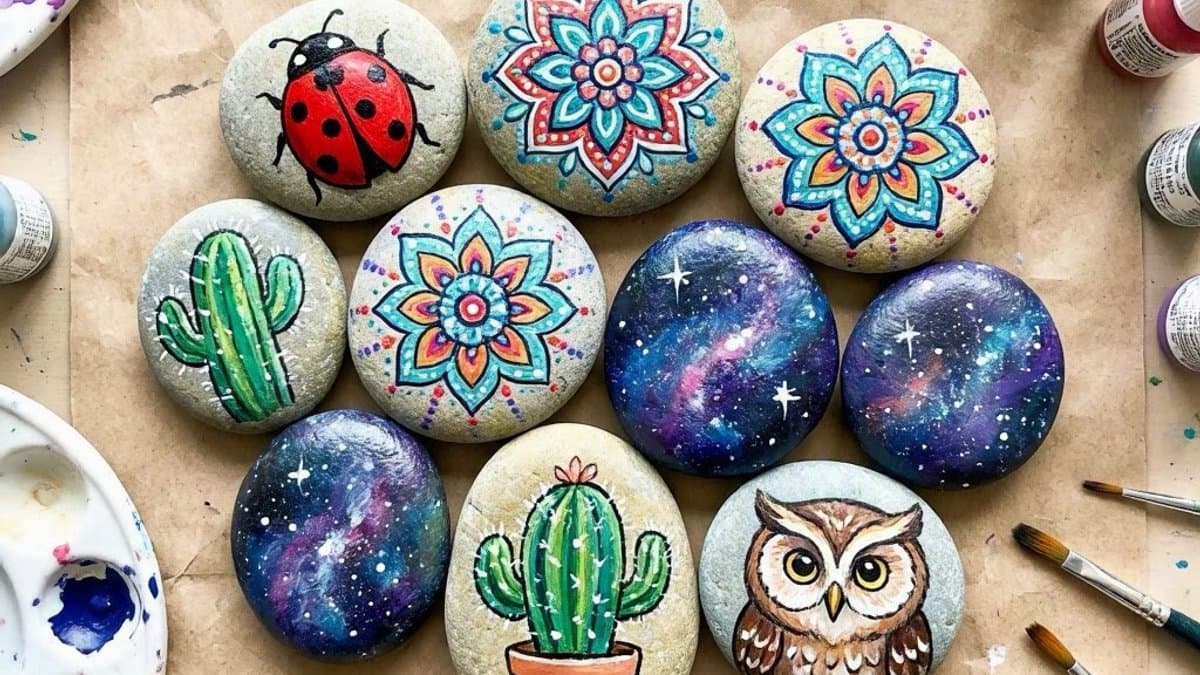
Paint the rock red, let it dry, then add a black head, a center line down the back, and black dots on the wings. Add tiny white eyes. This is the quintessential first rock painting project — simple enough for a four-year-old, satisfying for any age.
2. Dot-Painted Mandala Rocks
Apply dots in concentric circles using the end of a paintbrush handle, a cotton swab, or a dotting tool set. Start with a single dot in the center and work outward, alternating colors. The mandala builds organically and the results are stunning even on a first attempt. This technique is deeply calming and works for ages 5 through adult.
3. Kindness Rocks
Paint rocks with encouraging messages — "You are loved," "Be brave," "Today is your day," "You've got this" — and hide them in public places for strangers to find. This is the project that launched the worldwide kindness rocks movement. Children love the idea that their art might brighten a stranger's day.
Write the message first in pencil, then trace with paint pens or a fine brush. Decorate the background with simple flowers, hearts, stars, or patterns. Add "Pass it on" to the back.
4. Story Stones
Paint a set of 10-15 rocks with simple images — a house, a tree, a sun, a moon, a cat, a bird, a child, a monster, a boat, a mountain, a flower, a star, a rain cloud, a fish, a key. Place them in a bag. Draw three to five stones and use the images to create a story. This combines art with storytelling and imagination, and the set becomes a reusable game.
Story stones are excellent for imaginative play and language development. They also make wonderful gifts.
5. Alphabet Rocks
Paint each rock with a letter of the alphabet. Use one color for vowels and another for consonants if you want to build in a phonics lesson. Once complete, you have a set of 26 letter manipulatives that are far more engaging than plastic letters. Use them for spelling practice, letter hunts, and alphabetical ordering.
6. Cactus Rock Garden
Paint rocks in various green shades to look like different cactus species — round barrels, tall columns, prickly pears with paddle-shaped segments. Use white paint pens or toothpicks dipped in white paint for the spines. Plant them in a small pot filled with sand or pebbles. The result is an adorable, no-maintenance succulent garden.
7. Galaxy Rocks
Paint the rock black. While it is still wet, dab on dark blue, purple, and deep pink, blending slightly where colors meet. Let it dry. Flick white paint from a toothbrush for stars. Add a few larger white dots for bright stars. The effect is mesmerizing and much easier to achieve than it looks.
8. Animal Faces
Choose a rock whose shape suggests an animal — an oval for an owl, a round stone for a cat face, a long stone for a fish, a triangular stone for a fox. Paint the face with simple features. The key is letting the rock's natural shape guide the animal choice rather than forcing a shape that does not fit. This teaches children to observe and work with found materials.
9. Painted Rock Tic-Tac-Toe
Paint five rocks with X's and five with O's (or use two different designs — ladybugs vs. bumblebees, cats vs. dogs, stars vs. hearts). Find a flat rock or piece of driftwood and paint a tic-tac-toe grid on it. You now have a portable, outdoor-proof game set. This makes a great gift, especially when presented in a small drawstring bag.
10. Emoji Rocks
Paint rocks bright yellow and add emoji faces — laughing, heart-eyes, surprised, sleeping, silly tongue-out. Children love these because they combine something they recognize (digital emojis) with a hands-on craft. Use them for talking about emotions, playing matching games, or just decorating a desk.
11. Painted Rock Dominoes
Paint 28 rocks with domino dot patterns (all combinations from 0-0 to 6-6). Use a base color for each rock, add a dividing line, and place the correct number of white dots on each side. This creates a durable, beautiful domino set that can be played indoors or outdoors.
12. Garden Markers
Paint rocks with the names or pictures of herbs and vegetables — tomato, basil, lettuce, carrot, sunflower. Place them at the beginning of each row or next to each pot in your garden. This combines craft with gardening and gives children ownership of a part of the garden.
13. Constellation Rocks
Paint rocks dark blue or black. Add white dots in the pattern of recognizable constellations — the Big Dipper, Orion, Cassiopeia, Leo. Connect the dots with thin white lines. Write the constellation name on the back. This becomes both an art project and a stargazing reference set.
14. Seasonal Rock Collection
Paint a set of rocks for each season — snowflakes and mittens for winter, flowers and butterflies for spring, sun and watermelon for summer, leaves and pumpkins for fall. Display the current season's rocks on your nature table and rotate with the seasons.
15. Pet Rocks
The classic for a reason. Let each child choose a rock, paint it as an animal or imaginary creature, name it, and build it a home from a small box lined with fabric scraps or cotton. Younger children take pet rocks very seriously — they become companions, conversation partners, and beloved possessions. This is imaginative play at its simplest and best.
Tips for Success
Wash rocks first. Rinse collected rocks and let them dry completely. Paint adheres much better to clean, dry stone.
Use a base coat. A thin layer of white acrylic paint on the entire rock before decorating creates a brighter, more vivid surface for the final design. Let it dry completely before painting over it.
Work in layers. Paint the background color first, let it dry, then add details. Impatient layering leads to muddy colors.
Seal outdoor rocks. Any rock that will live outside needs 2-3 coats of clear acrylic sealant to protect the paint from rain and sun. An adult should apply spray sealant in a ventilated area.
Display the collection. A painted rock left in a drawer is a painted rock forgotten. Keep a bowl, tray, or shelf where the family's painted rocks accumulate. The growing collection becomes a source of pride and a conversation piece.
Rock painting is proof that the best children's activities are often the simplest. A rock, some paint, and time — that is all it takes to turn a piece of the natural world into something personal, beautiful, and lasting.
Frequently Asked Questions
- What kind of paint works best for painting rocks?
- Acrylic paint is the best choice for rock painting. It is inexpensive, comes in vibrant colors, dries quickly, is water-resistant when dry, and cleans up with water while wet. Acrylic paint pens are even easier for children who struggle with brushes — they offer fine control without the mess. Tempera paint works for very young children but will wash off outdoors. For permanent outdoor rocks, seal finished pieces with a clear acrylic spray or brush-on sealant.
- What are the best rocks for painting?
- Smooth, flat rocks with a light-colored surface work best. River rocks are ideal — they are naturally tumbled smooth and come in paintable shapes. Avoid very porous or rough rocks, as paint does not adhere well and details are impossible. If you cannot find good rocks locally, craft stores sell bags of smooth river rocks specifically for painting, or you can order them online.
- How do you seal painted rocks so they last outside?
- Once the paint is completely dry (wait at least 24 hours), apply 2-3 coats of clear acrylic sealant. Spray sealant (like Mod Podge clear acrylic sealer) is easiest — spray in light, even coats, letting each coat dry before applying the next. Brush-on polyurethane also works well. Sealed rocks can last years outdoors. Unsealed acrylic paint will eventually fade and chip in weather.
- Is rock painting safe for toddlers?
- Yes, with supervision. Use non-toxic acrylic paint or washable tempera paint for children under 3. Ensure rocks are large enough that they cannot be a choking hazard. Paint on a covered surface and dress in old clothes. Toddlers will not create detailed designs, but they love covering rocks with color — and that is perfectly fine. The process matters more than the product at this age.
- Where can I hide painted rocks?
- Popular hiding spots include parks, playgrounds, hiking trails, library grounds, neighborhood sidewalks, community gardens, Little Free Libraries, and any public space where someone might find them and smile. Many communities have Facebook groups for local rock hiding and finding. Always make sure the location allows it — some parks and nature preserves ask that you do not leave painted rocks as they can be mistaken for litter.
Enjoying this article?
Get more ideas like this delivered to your inbox every week.