Best Homeschool Math Manipulatives (What Actually Helps Kids Learn Math)
The math manipulatives that actually help kids understand math — base ten blocks, fraction tiles, pattern blocks, and more. What's worth buying and what's overrated.
By The Slow Childhood
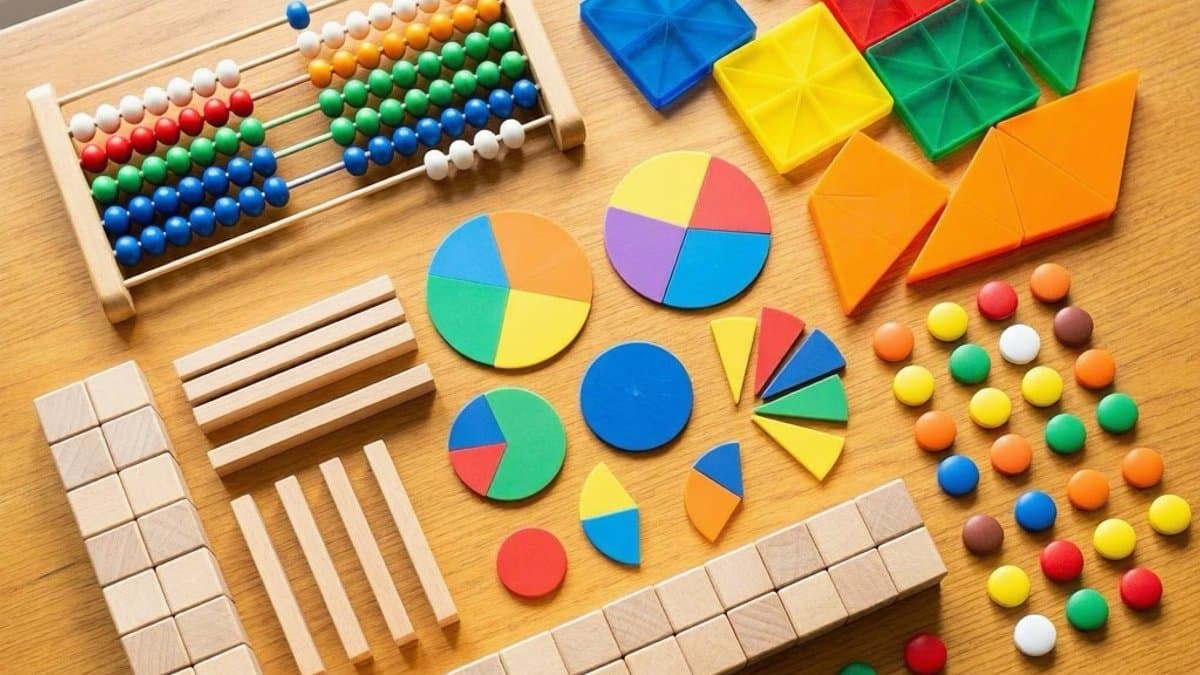
Math manipulatives are the bridge between abstract numerical concepts and the physical world. A child holding ten ones-cubes and exchanging them for one tens-rod isn't just doing busywork — they're building the mental model of place value that will serve them through algebra, calculus, and beyond. Skip the manipulative stage too quickly and you skip the foundational understanding.
This guide covers the manipulatives that actually help kids learn math — what's worth buying, what's optional, and how to use each effectively.
Essential Manipulatives Every Homeschool Needs
Base Ten Blocks
Base Ten Blocks are the single most important math manipulative. The set includes ones (small cubes), tens (rods of 10 cubes), hundreds (flats of 100 cubes), and a thousand (a large cube of 1000). Children physically build numbers, exchange ones for tens, and visualize place value, addition, subtraction, multiplication, and division.
Use for: Place value, all four basic operations, area, volume, decimals Plastic option: Learning Resources Base Ten Blocks (~$30) Wooden option: Melissa & Doug Wooden Base Ten Blocks Ages: Pre-K through 5th grade Best for: Every homeschool — these are non-negotiable.
Pattern Blocks
Pattern Blocks are colorful geometric shapes (triangles, squares, hexagons, trapezoids, parallelograms, rhombuses) that fit together in countless ways. Children explore symmetry, fractions, geometry, and design.
Use for: Geometry, fractions (especially halves, thirds, sixths), symmetry, tessellation Wooden: Melissa & Doug Pattern Blocks — beautiful and substantial Ages: 3+ through middle school Best for: Spatial reasoning and geometry foundation.
Fraction Tiles or Fraction Circles
Fraction Tiles and Fraction Circles make fractions visible and manipulable. Children compare fractions, add fractions, find equivalent fractions, and build genuine understanding.
Use for: All fraction concepts in 3rd-5th grade math Best for: Every homeschool reaching fractions (around 3rd grade).
Counters
Counters (small plastic discs or animals) support early counting, sorting, basic addition and subtraction, and probability work. Different colors enable problems involving combining or separating groups.
Best for: Pre-K through early elementary; specific to early arithmetic.
100 Chart
A 100 chart (numbers 1-100 in a 10x10 grid) supports counting, skip counting, addition, subtraction, and pattern recognition. Magnetic versions allow flexible use.
Best for: K-2 math; ongoing reference even in higher grades.
Specialized Manipulatives Worth Considering
Cuisenaire Rods
Cuisenaire Rods are colored rods of different lengths (1cm-10cm) that represent quantities visually. Each color is a specific length, so children can compare, add, multiply, and explore relationships. Particularly powerful for fraction and ratio work.
Best for: Singapore Math users; supplementing any program with visual math experience.
Geometric Solids
Geometric Solids — actual 3D shapes (cube, sphere, cylinder, cone, pyramid, prism) — make geometry tangible. Children compare faces, edges, vertices, and explore volume and surface area.
Best for: Geometry instruction in upper elementary and middle school.
Geoboards
Geoboards (boards with pegs and rubber bands) let children create and explore geometric shapes hands-on. Excellent for learning about polygons, area, perimeter, and angles.
Best for: Hands-on geometry exploration.
Place Value Disks
Place Value Disks provide an alternative or supplement to base ten blocks. Smaller and more abstract — better for upper elementary work involving large numbers.
Best for: 3rd-5th grade place value with thousands and ten-thousands.
Two-Color Counters
Two-Color Counters (yellow on one side, red on the other) support work with positive and negative numbers, integers, and probability work in upper elementary and middle school.
Best for: Integer work in 5th-7th grade.
Tangrams
Tangrams (seven geometric pieces forming a square) develop spatial reasoning, geometric thinking, and problem-solving. Children create animals, letters, and abstract designs from the same seven pieces.
Best for: Geometry; logic and reasoning development.
Math Balance / Pan Balance
A pan balance makes weight, equality, and pre-algebraic thinking concrete. "If 5 cubes balance with 5 cubes, what happens if we add one to each side?" becomes a question children can investigate physically.
Best for: Concept development for equations and algebraic thinking.
What's Overrated
Specialty manipulatives for narrow purposes. Some manipulatives only address one specific concept — and that concept could be taught with general-purpose manipulatives just as well. Skip the specialty fraction-only or measurement-only kits unless you're addressing specific gaps.
Electronic manipulatives. Some companies sell electronic math toys that claim to be manipulatives. Real manipulatives — physical objects children handle — work better than digital approximations.
Massive multi-set bundles. "Everything you need!" 500-piece manipulative bundles often include unneeded items. Build your collection deliberately, adding what you actually need rather than getting overwhelmed with too much at once.
Storing and Using Manipulatives
Visible storage matters. Manipulatives in a closed cabinet rarely come out. Clear plastic storage bins on accessible shelves invite use.
Sort by category, not all together. Base ten blocks separate from pattern blocks separate from fraction pieces. Mixed bins frustrate everyone.
Keep them out during math time. A child halfway through a problem who suddenly needs to visualize something can grab the right manipulative immediately if it's at the table.
Use beyond grade-level expectations. Don't pull manipulatives away because "she's old enough to do this in her head now." If she's struggling, manipulatives help. If she's not, they don't slow her down.
When to Phase Out Manipulatives
Children naturally move from concrete to pictorial to abstract math. Watch for signs your child is ready:
- They can solve similar problems without manipulatives
- They use manipulatives only briefly to check answers
- They explain their reasoning verbally without referring to physical objects
- They become impatient with manipulatives, finding them slow
When children show these signs, fade manipulatives gradually. Keep them available but don't insist on them. Many children move back and forth between concrete and abstract for a year or two — this is normal and good.
For more on math instruction, see our guides to best math curriculum for early learners, homeschool math games and activities, and best homeschool curriculum for first grade.
The right math manipulatives, used generously and patiently, build the deep number sense that supports a lifetime of mathematical confidence. Buy good ones, keep them accessible, and let your children manipulate their way to understanding.
Frequently Asked Questions
- What math manipulatives should every homeschool have?
- The essentials are: base ten blocks (for place value, addition, subtraction, multiplication, division), pattern blocks (for fractions, geometry, symmetry), fraction tiles or fraction circles (for fractions), counters (for early counting and basic operations), and a 100-chart. These five categories cover virtually all elementary math instruction. More specialized manipulatives can be added as specific topics arise.
- Do kids really need manipulatives, or are they just busywork?
- For most children, manipulatives are essential, not busywork. Children learn abstract math through concrete experience first. A child who has built 24 from two tens-rods and four ones-cubes understands place value at a level no worksheet can teach. Once children genuinely understand a concept, they don't need the manipulative anymore — they can work abstractly. Skip manipulatives only when your child clearly already understands; otherwise, use them generously.
- Are wooden or plastic manipulatives better?
- Both work, with different tradeoffs. Wooden manipulatives feel better, look better, and last longer — but cost more and weigh more. Plastic manipulatives are usually more affordable, available in brighter colors, and lighter for storage — but show wear faster and feel cheaper. For heirloom-quality pieces used across multiple children, wood wins. For practical use across years of homeschool, quality plastic is fine. Avoid the cheapest options of either material.
- How do I know if my child needs more manipulative practice?
- Watch for these signs: makes errors that suggest guessing rather than understanding, rushes through worksheets without engagement, can't explain how they got an answer, struggles with word problems even when they can do similar bare numerical problems. These all suggest concepts haven't moved from concrete to abstract yet. Bring back manipulatives, slow down, and rebuild the foundation. There's no shame in using manipulatives longer than the curriculum suggests — every child develops at their own pace.
Enjoying this article?
Get more ideas like this delivered to your inbox every week.