Screen-Free Road Trips: Entertainment and Activities for Car Time
Hours in the car can be some of the best family time of the summer. Here is how we keep our kids engaged on long drives without screens, plus the games, kits, and rhythms that actually work mile after mile.
By The Slow Childhood
There is a particular kind of summer afternoon I have come to love: the second hour of a long drive, when the highway noise has settled into white noise, someone in the back is halfway through a sticker scene, and a debate about whether a hot dog counts as a sandwich is gathering steam in the third row. No one is staring at a screen. We are, somehow, all together in a moving metal box with nowhere else to be — and it is wonderful.
It did not used to look like this. Our early road trips were a scramble of dying tablets, tangled charging cords, and the strange post-screen grumpiness that settled over the kids the moment the battery died an hour from the destination. The shift to screen-free car time was not about being purists. It was about noticing that the screen drives ended with tired, overstimulated children, while the screen-free ones ended with kids who had actually seen the trip. Summer, with its long unhurried drives to the lake, the campground, the grandparents three states away, turned out to be the perfect season to lean in. Here is exactly how we do it, including the gear that earns its place and the rhythms that hold a drive together mile after mile.
Why Screen-Free Car Time Is Worth Protecting
This is not screen-shaming. We have handed over a tablet on a red-eye flight with a sick toddler and felt zero guilt. But car travel is a uniquely good place to go without, and it is worth understanding why before you commit to the slightly-more-effort path.
A screen pulls a child's gaze down and in. A screen-free drive turns it up and out — toward the changing landscape, the grain elevators and water towers, the way the trees thin as you climb into the mountains. That window is a free, continuous geography and natural-history lesson, and kids who spend the drive inside a video arrive at the destination having traveled nowhere.
Then there is the conversation. Some of the best, most unguarded talks I have ever had with my kids happened in the car, sparked by a road sign or a question that wandered in from nowhere. A car where everyone is plugged into separate screens is a silent car. A car running a chaotic game of 20 Questions is a connected one. And the unglamorous bonus: screen-free kids practice tolerating a stretch of nothing-to-do, which is a genuine life skill. If you are already building screen-free habits at home, our roundup of screen-time alternatives for kids pairs naturally with this approach, and a long drive is just that philosophy applied at 65 miles per hour.
Pack First: The Per-Child Activity Bag
The single best thing you can do for a screen-free drive happens the night before, on your living room floor. Build one dedicated activity bag per child. This matters more than any individual product, because a child who has to ask you to dig something out of the trunk is a child who has already lost interest.
Use a small backpack or a structured zip pouch each kid can reach without unbuckling. Mine each get a few constants — a spill-proof straw water bottle, a snack container, and a comfort item — plus age-appropriate activities. The trick that has saved more drives than anything else: wrap two or three items in tissue paper as little surprise packages to be opened at milestones. The unwrapping itself buys you ten minutes, and the anticipation buys you more.
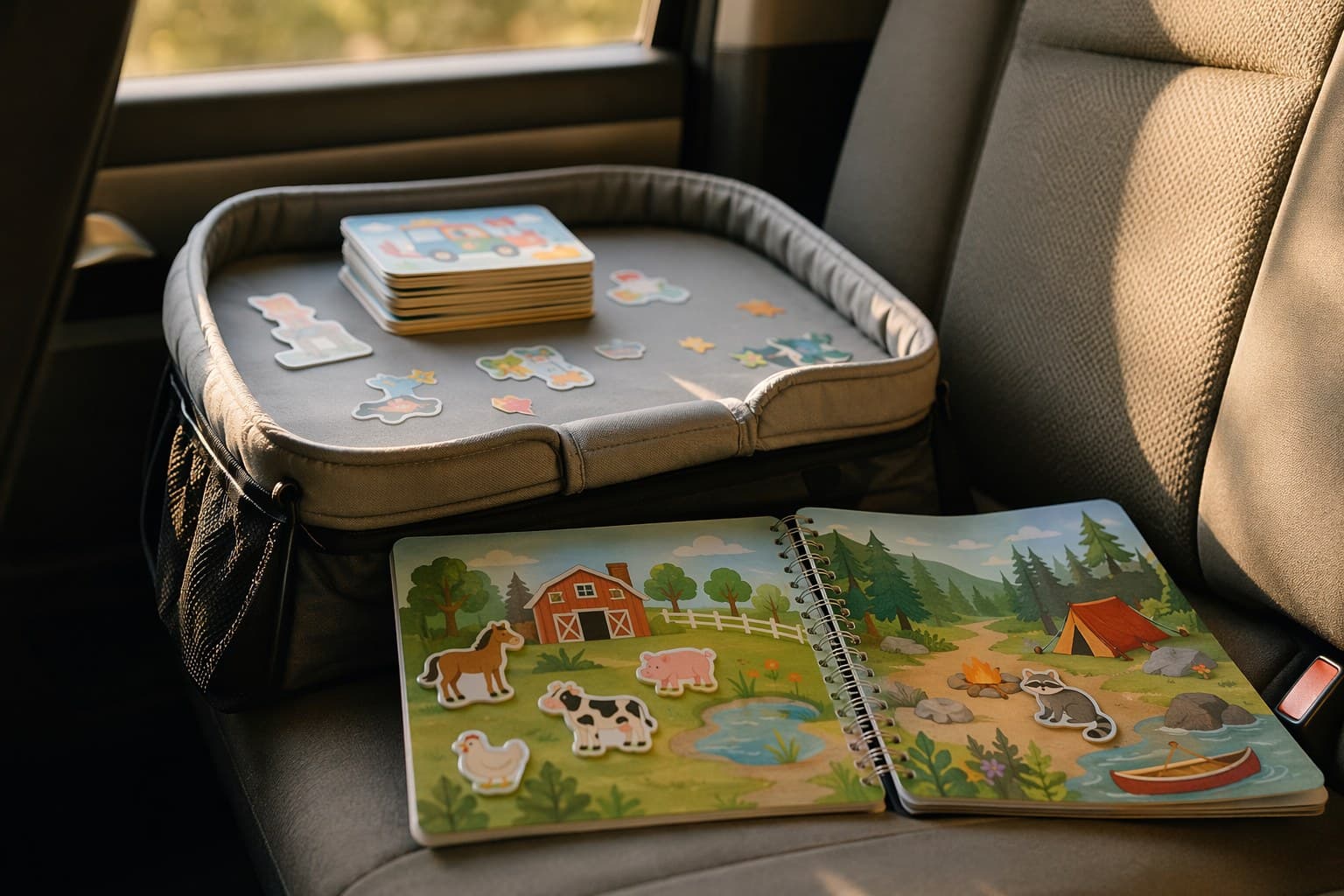
A surface to work on changes everything for the hands-on activities. A padded car seat activity tray gives little hands a stable, raised platform so crayons and puzzle pieces do not vanish into the seat-crack abyss every thirty seconds. It is the unsung hero of the screen-free car, and it is the first thing I tell new road-trip families to buy.
Hands-On Activities for a Stable Surface
These are the quiet, heads-down activities — the ones that let one child focus while you run a game with the others or simply enjoy ten minutes of highway silence.
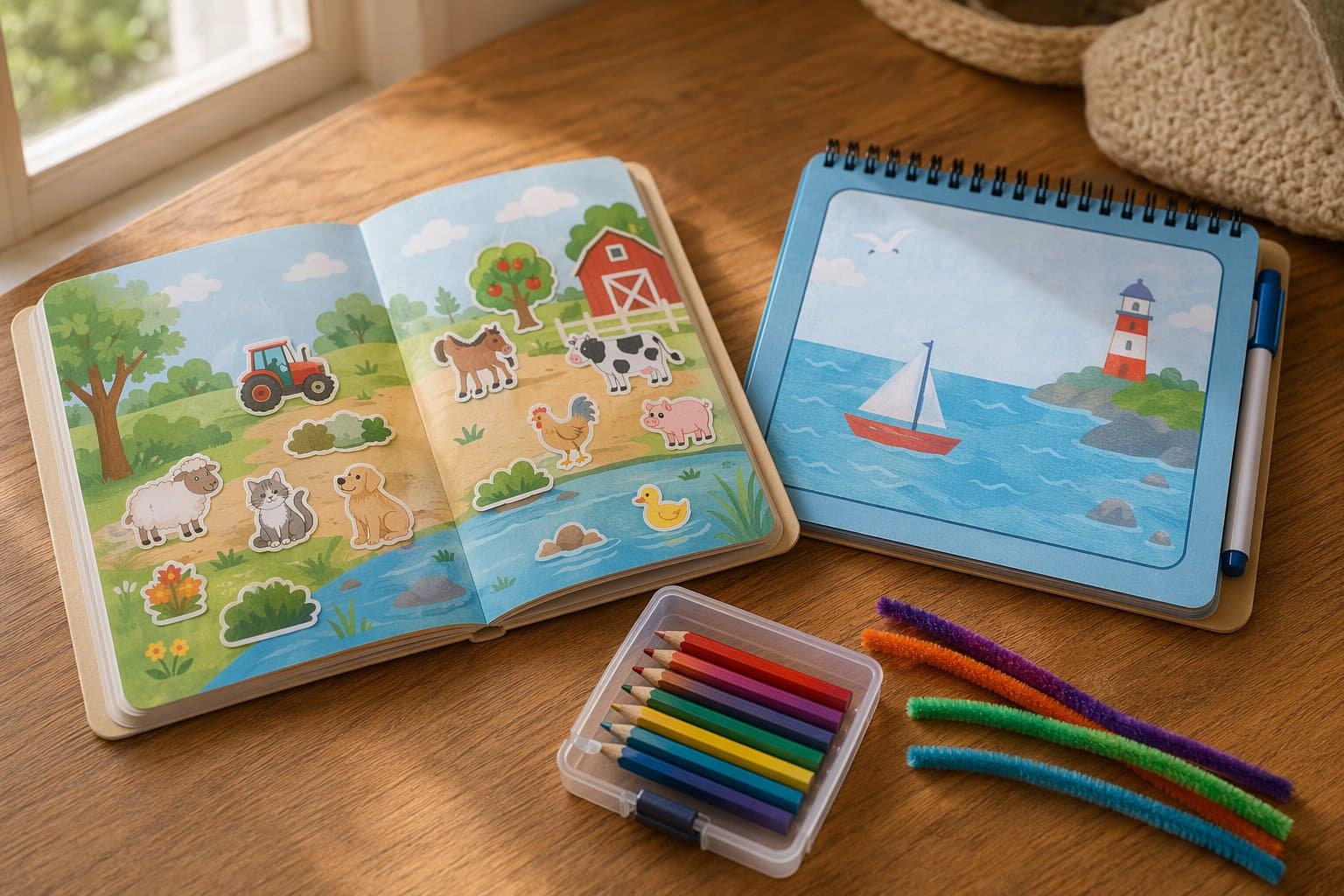
Reusable sticker scenes. The undisputed champion for ages three through seven. Unlike paper stickers, a set of reusable sticker scene books can be peeled and replaced endlessly, so a single farm or town scene becomes a new story every time. The narrative element is what gives it staying power — kids are not just placing stickers, they are deciding where the cow goes and why the firetruck is at the bakery.
Travel activity books. A good travel activity book set with mazes, dot-to-dots, spot-the-difference, and simple puzzles is the workhorse of the elementary years. Look for spiral-bound ones that lie flat on a tray and have thick paper that holds up to a colored pencil pressed by an enthusiastic six-year-old. Pair it with a clipped-on pencil case so nothing rolls away.
Magnetic puzzles and doodle boards. For the youngest passengers, a magnetic drawing board is close to magic: draw, erase, repeat, with no loose pieces and nothing to run out of. Magnetic puzzle tins keep their parts contained, which matters enormously in a moving car.
Pipe cleaners and wikki sticks. A fistful of bendable craft stems weighs nothing, makes no mess, and turns into bracelets, letters, and tiny sculptures. Underrated and nearly free.
The discipline with all of these is to put an activity away while the child is still enjoying it. End on a high note and they will be glad to see it return in an hour. Let it run until they are sick of it and you have burned a tool you cannot get back. This is the same logic behind a well-stocked family game night with no screens at home — rotation and freshness keep the magic alive.
Out-the-Window Games for the Whole Car
This is where the real connection lives. These games need no supplies beyond a willing crowd, though a couple of structured tools make them sing.
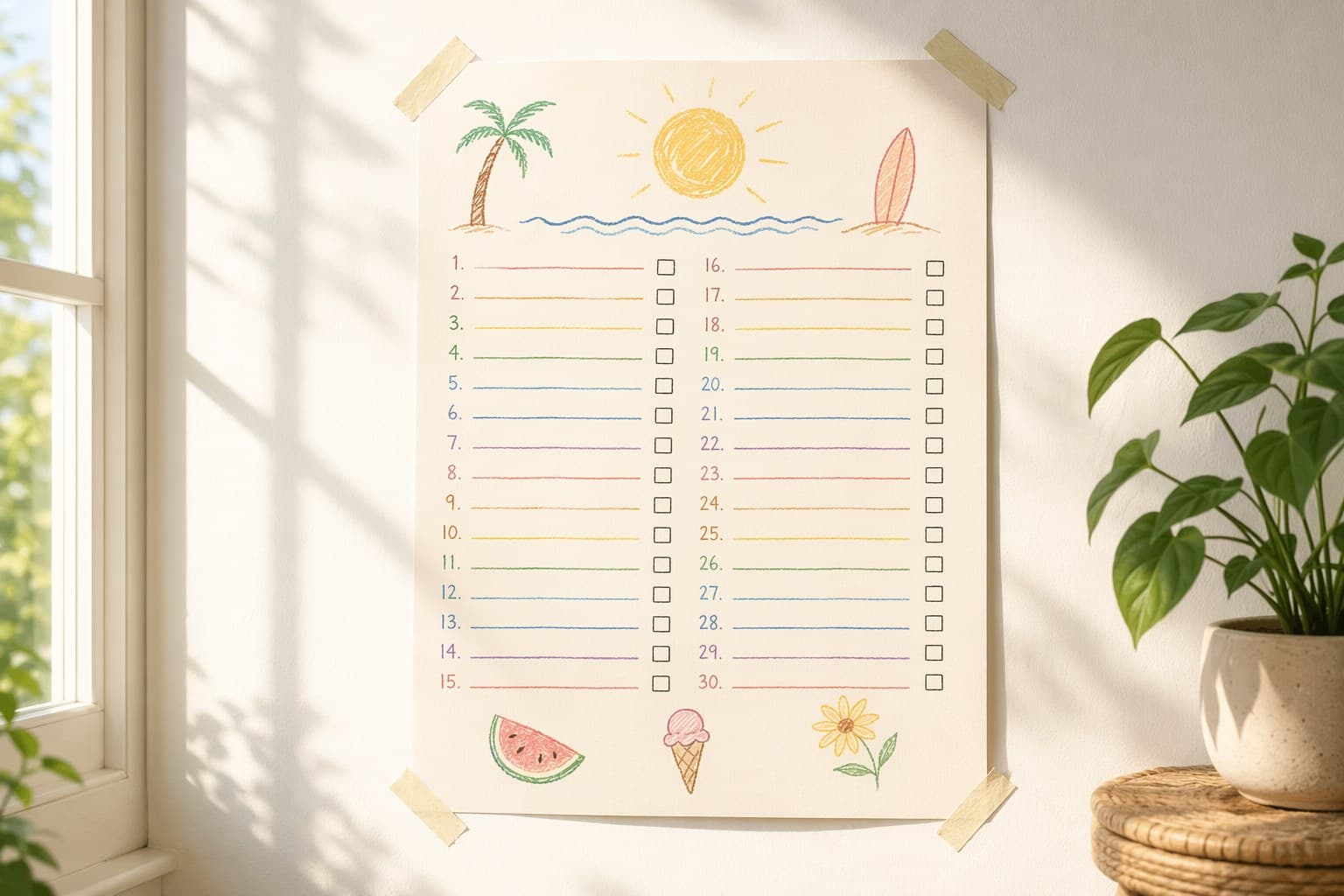
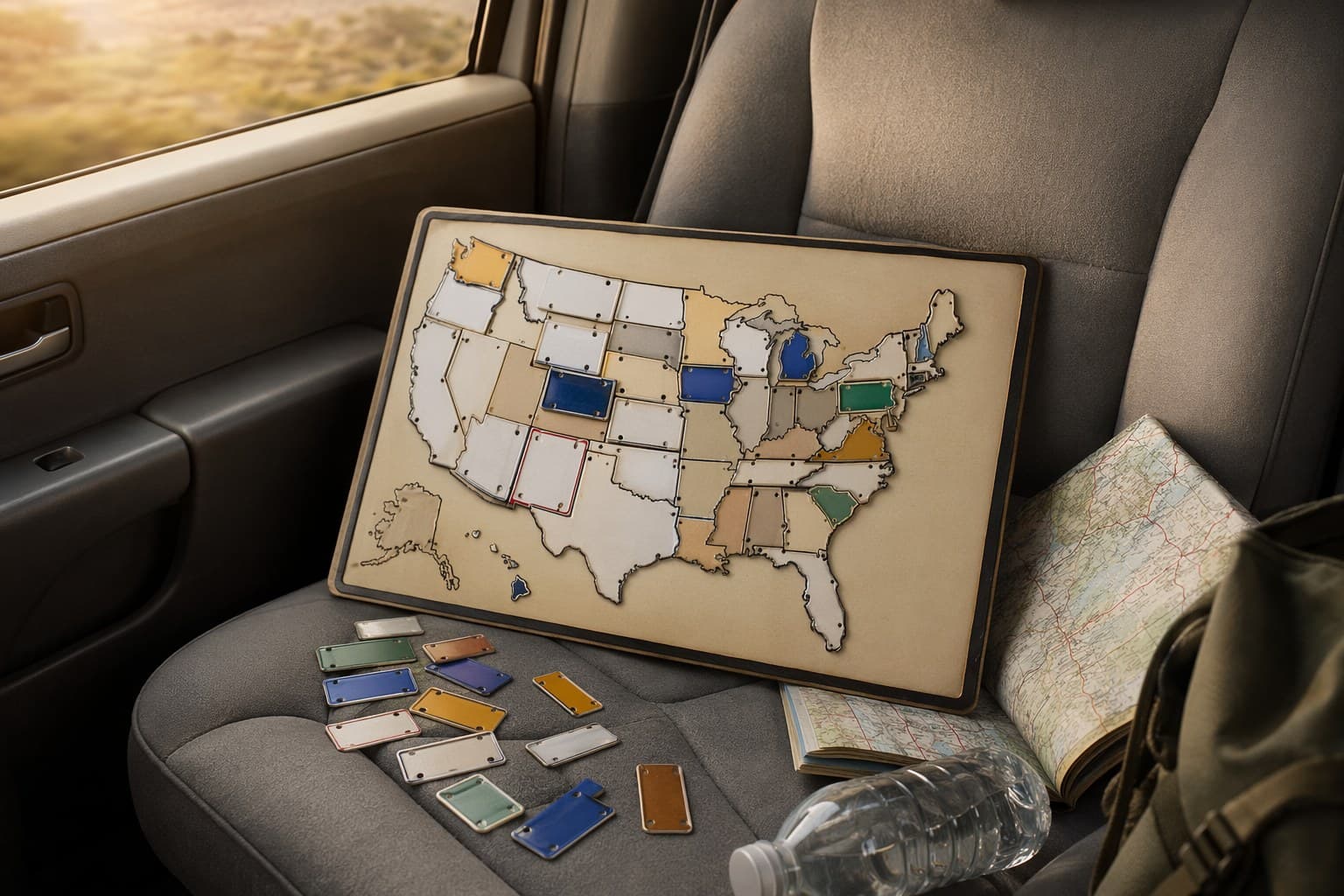
The license plate game. Our family's gold-standard road trip tradition. A dedicated license plate game book or board with a map you check off as you spot each state turns the entire drive into one long, low-grade treasure hunt. Spotting a Hawaii or Alaska plate in the middle of the country becomes a genuine event — last summer my son shrieked loudly enough that I thought we had a flat tire. It teaches geography painlessly and gives the trip a goal that spans every mile.
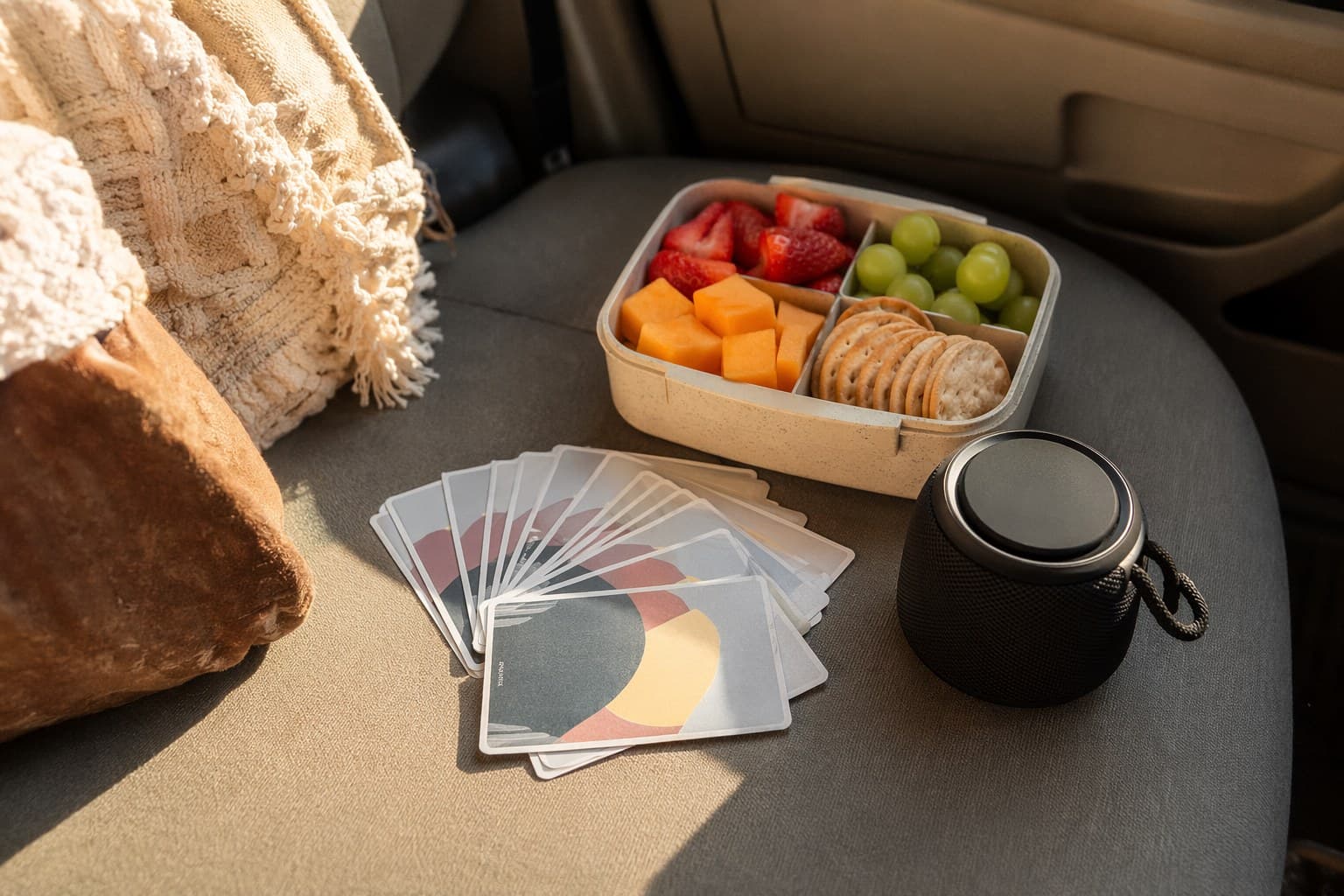
Travel game cards. A compact deck designed for the car carries a whole arsenal of prompts and challenges in your cup holder. A good compact travel game card set covers Would You Rather, scavenger-hunt spotting cards, conversation starters, and quick challenges, so when inspiration runs dry you just draw a card. These are the thing I reach for at hour four when my own creativity is spent.
I Spy and 20 Questions. The classics earn their reputation. For little ones, keep I Spy to colors and objects inside the car, since roadside things vanish too fast. For older kids, 20 Questions is a quietly brilliant exercise in deductive reasoning — start by establishing the category, then narrow.
The alphabet hunt. Each player races to find letters A through Z in order on signs, plates, and billboards. Q, X, and Z turn the endgame into genuine drama, and a single well-placed exit sign for a "Quality Inn" can win the round.
The storytelling chain. One person starts a story with a sentence, the next adds a line, and it travels around the car. Our stories reliably collapse into nonsense about a llama who runs a submarine, and the laughter is the entire point.
If you want a deeper menu of car games sorted by exact age, our companion piece on screen-free road trip activities breaks down thirty-five of them from toddler to tween.
Listening Time: The Hour That Saves Everyone
There comes a point on every long drive — usually mid-afternoon, somewhere unscenic — when the games have run their course and the hands-on bag has lost its shine. This is what audio is for, and it is the most powerful screen-free tool you have.
A great family audiobook can hold an entire car spellbound for hours. We have driven past our exit because no one wanted to break the spell of a good chapter. The classics deliver: the Magic Tree House series for the younger crowd, the Ramona books, anything Roald Dahl, and the Harry Potter audiobooks narrated by Jim Dale for the seven-and-up set. Download from a library app like Libby before you leave so you are not at the mercy of rural cell coverage.
Kid podcasts are the other half of this. Brains On for the science-curious, But Why for the relentless question-askers, Story Pirates for stories written by kids themselves. They are episodic, free, and genuinely funny enough that the adults stay engaged too. A small bluetooth car speaker playing for the whole car beats individual headphones for younger kids, who will yank earbuds out within seconds anyway, and it keeps listening a shared family experience rather than four separate isolated ones.
The Rhythm That Holds a Drive Together
Gear and games are only half of it. The other half is timing, and getting the rhythm right is the difference between a pleasant drive and a death march.
Rotate every 30 to 45 minutes. Proactively switch lanes between hands-on, window games, and listening — even when a child still seems content. You are managing energy, not waiting for a crash.
Use snacks as transitions. "Let's have a snack, then play license plates." A snack is a natural reset button that buys calm and signals a new activity is coming. Variety in a divided snack container holds attention far longer than one big bag of the same thing.
Stop more than feels efficient. Plan a movement break every 90 minutes to two hours for toddlers, stretching toward three hours for older kids. The destination is not a rest stop with a vending machine — it is a park, a grassy rest area, a field where everyone can sprint and shake out the wiggles. A fifteen-minute run buys you another smooth ninety in the seat, every single time.
Front-load, then relax. The work is the night before. Pack the bags, charge the speaker, download the audiobook, prep the snacks. Then, on the road, you mostly just hand things back and referee. The prep makes the drive feel effortless.
The Honest Expectation
I want to be straight with you, because the glossy version of this helps no one: there is no road trip, screen or screen-free, that is entirely peaceful. Someone will whine. A sibling skirmish will erupt over a dropped crayon. There will be a thirty-minute stretch where nothing works and you grip the wheel and just drive. That is not the no-screen approach failing. That is simply travel with children.
The goal was never a silent, serene car. It is a car full of kids who are awake to the trip — spotting a Wyoming plate, arguing happily over Would You Rather, drifting off to a chapter of a good book with the summer landscape sliding past the window. The destination fades surprisingly fast in their memories. What stays is the license plate map we filled in together, the ridiculous llama-submarine saga, the snack we always stop for at the same gas station. That shared, unhurried, screen-free time in the car turns out not to be the boring part of the trip you endure to reach the good part. Quite often, it is the good part.
Frequently Asked Questions
The questions in the FAQ section above are the ones we hear most from families about to attempt their first long screen-free drive — what kids can actually do for hours, how to survive it with a toddler, and whether the extra packing is genuinely worth it. The short version: build a per-child activity bag the night before, rotate between hands-on play, window games, and audio every 30 to 45 minutes, stop often enough to let bodies move, and let go of the fantasy of a silent car. Engaged and connected beats quiet and glazed every time.
Frequently Asked Questions
- What can kids do on a long car ride without screens?
- Plenty, and most of it is more memorable than a tablet. Rotate between three buckets: hands-on activities at a stable surface (sticker scenes, activity books, magnetic puzzles on a lap tray), out-the-window games that involve the whole car (license plate hunts, I Spy, 20 Questions), and listening time (audiobooks and kid podcasts). Switch buckets every 30 to 45 minutes before boredom sets in, and use snacks as the bridge between activities. The variety is what keeps a screen-free drive sustainable for hours.
- How do I keep a toddler happy in the car without a screen?
- Toddlers are the hardest passengers because they cannot wait or follow rules, so the strategy is frequent rotation and frequent stops rather than long activities. Pack reusable cling stickers for the window at their eye level, a magnetic doodle board, a few finger puppets, and a snack container with variety. Plan a movement break every 90 minutes to two hours. Accept that some stretches will be loud — that is normal, not a sign the no-screen approach is failing.
- Are screen-free road trips actually worth the extra effort?
- In our experience, yes. Kids who watch the landscape change, count license plates, and listen to a shared audiobook arrive curious and connected instead of glazed and cranky. They build verbal skills, geography sense, and the underrated ability to tolerate a little boredom. The prep is front-loaded — one afternoon packing activity bags — and then the drive runs itself. The conversations and inside jokes that come out of a screen-free car often become the part of the trip everyone remembers.
Enjoying this article?
Get more ideas like this delivered to your inbox every week.