20 Beach Activities for Kids That Go Way Beyond Sandcastles
Screen-free beach activities that keep kids engaged for hours — from tide pool exploration and driftwood forts to sand art and shore fishing. No expensive toys needed.
By The Slow Childhood
The beach is the original screen-free playground. Every wave that rolls in rearranges the sand, delivers new treasures, and creates a fresh canvas for play. Children do not need beach toys, organized games, or parental entertainment at the shore — they need time, freedom, and perhaps a bucket. The beach teaches physics (waves, erosion, buoyancy), biology (tide pools, shore birds, sea creatures), geology (rocks, sand, fossils), and art (sculpture, pattern, ephemeral creation) without a single lesson plan.
These 20 activities go beyond basic sandcastles to give your family ideas for every age, every tide, and every type of beach — rocky shores, sandy stretches, sheltered coves, and windswept dunes. Most require nothing more than what the beach provides.
Why the Beach Is Unmatched for Child Development
Research from the University of Plymouth found that children who regularly visit coastal environments show higher levels of physical activity, emotional well-being, and connection to nature than those who do not. The beach engages every sense simultaneously — the sound of waves, the feel of sand and water, the smell of salt air, the visual expanse of ocean and sky, even the taste of salt on lips. This multisensory immersion is exactly what developing brains need.
The beach also teaches patience and impermanence in ways that no classroom can. A sandcastle washed away by the tide is a gentle lesson in letting go. A shell found after an hour of searching is a lesson in persistence. The constantly changing shoreline teaches children to observe carefully and adapt their plans — skills that transfer to every area of life.
If you have been working on screen-free habits at home, a beach day is a powerful reinforcement. No child has ever asked for a tablet while watching a hermit crab change shells.
Sand Activities (Ages 2-12)
1. Sand Rivers and Channel Systems
Move beyond the simple hole-in-the-sand. Dig a network of channels from a higher point toward the water, creating dams, reservoirs, and river systems. Pour water from a bucket at the top and watch it flow. Adjust the channels, widen some, narrow others, and build dams to control the flow. This is engineering in its purest form — children learn about gravity, water flow, erosion, and structural design while getting thoroughly sandy.
For older kids, challenge them to build a system that carries water from one bucket to another across several feet of beach, using only sand channels and natural materials.
2. Sand Sculpture Beyond Castles
Sandcastles are wonderful, but the medium allows for much more. Try sculpting animals — sea turtles, whales, starfish, octopuses — using wet sand packed firmly and carved with sticks or shells. Build a sand sofa and actually sit in it. Create a life-size mermaid or buried pirate. Sculpt a giant hand emerging from the sand. The only limit is imagination and the tide clock.
Tip: The best sculpting sand is found a few inches below the dry surface layer. Dig down to find the darker, wetter sand that packs firmly and holds detail. A sand sculpting tool set can be fun but is absolutely not necessary — hands, sticks, and shells work beautifully.
3. Beach Art Mandalas
Collect natural materials — shells, pebbles, sea glass, seaweed, feathers, driftwood pieces — and arrange them in circular patterns on flat sand. Start with a center point and work outward in rings, alternating materials. The result is stunning temporary art that photographs beautifully and washes away with the next tide.
This activity is deeply calming and works for all ages. Toddlers can place items in rough circles while older children create intricate, symmetrical designs. It connects beautifully with nature art projects you might do at home.
4. Buried Treasure Hunt
Before the kids arrive at the beach (or while they are distracted), bury small items in a defined area — shells, coins, small toys, or smooth stones you have painted. Mark the area with sticks and let children dig for treasure. For older kids, draw a treasure map with landmarks (the big rock, the driftwood log, the lifeguard stand) and compass directions.
5. Sand Writing and Drawing
Use sticks, fingers, or the edge of a shell to write and draw in wet sand. Practice letters and numbers with toddlers. Write messages for the tide to erase. Draw enormous pictures visible from the dunes above. Create a beach newspaper with headlines written in sand. The impermanence removes all pressure — every mark can be smoothed away and started over.
Water's Edge Activities (Ages 3-12)
6. Wave Jumping and Dodge
Stand at the water's edge and jump over incoming waves. Start with small waves for little ones and gradually move deeper for older children. Play wave dodge — stand in a line and try to avoid getting hit by the wave's reach. The child who stays driest wins. This simple game generates more laughter per minute than almost anything else at the beach.
7. Stone Skipping
Find flat, smooth stones and practice skipping them across calm water. Teach the technique: hold the stone flat between thumb and index finger, keep your arm low, snap your wrist, and release at a slight upward angle. Count skips and try to beat personal records. This is a skill that takes genuine practice, and children who master it feel an enormous sense of accomplishment.
8. Shore Fishing
You do not need a boat or expensive gear. A simple kids fishing rod and some bait (bread, shrimp, or sandworms from a tackle shop) can provide hours of patient, focused activity. Even if nothing bites, the act of casting, watching the line, and waiting teaches patience and attentiveness. Check local regulations for licensing requirements and size limits.
9. Tidal Race Course
At low tide, find a gently sloping section of beach where water flows back to the ocean in thin sheets. Place lightweight natural objects — small sticks, leaves, seed pods — at the top of the slope and race them as the retreating water carries them downhill. Dig channels to redirect the flow and create obstacles. This is hours of entertainment for very little effort.
10. Message in a Bottle
Bring a small glass bottle with a cork, paper, and a pencil. Write messages, draw pictures, or create tiny scrolled letters. Talk about ocean currents and where a bottle might travel. While you should not actually throw the bottle in the ocean (beach litter is a serious problem), the act of creating the message and imagining its journey sparks wonderful conversations about geography, oceans, and connection.
Tide Pool and Nature Activities (Ages 4-12)
11. Tide Pool Exploration
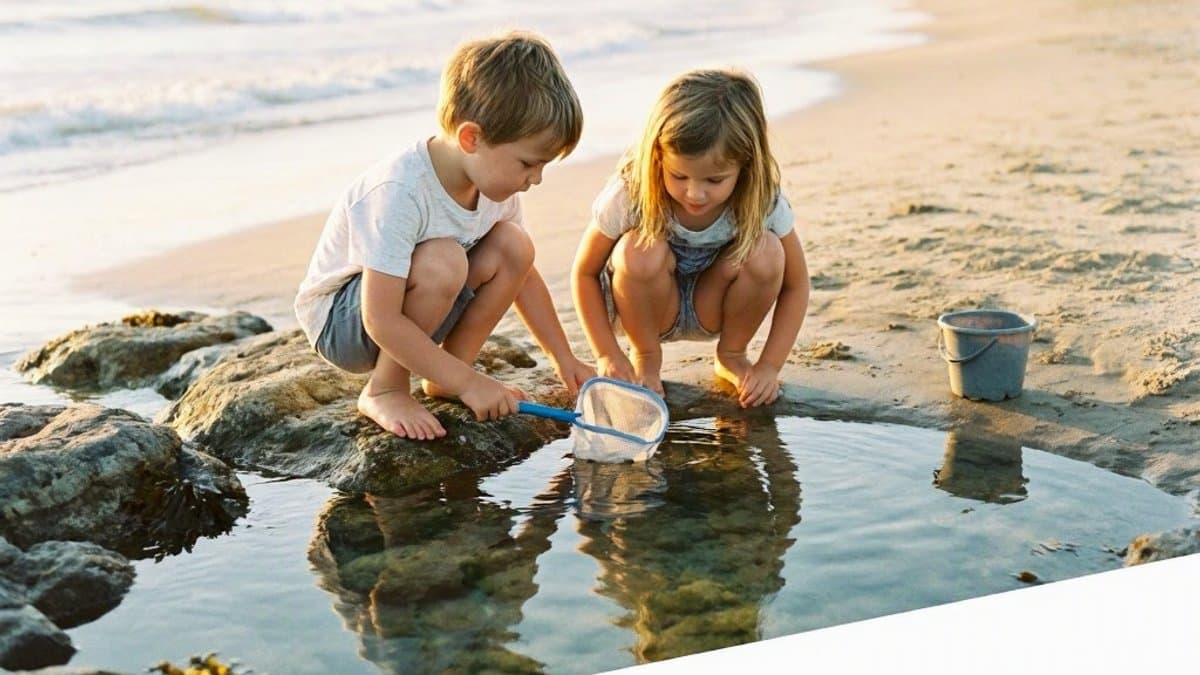
Rocky beaches at low tide reveal an entire hidden world. Bring a magnifying glass and a tide pool field guide and look for sea anemones, hermit crabs, starfish, small fish, sea urchins, snails, barnacles, and algae. Teach children to look without touching (or touch gently with one wet finger) and to never remove creatures from tide pools.
Tide pool exploration is one of the best outdoor nature activities available — it combines observation, identification, patience, and genuine wonder in a way that captivates children of every age.
12. Shell Collecting and Identification
Give each child a mesh bag and set out on a shell walk. Look for different species, sizes, colors, and conditions. Back at your beach blanket, sort the collection by type, size, or color. Use a shell identification guide to name what you find. Discuss how each shell was once home to a living creature and what that creature might have been.
Keep a few favorites and return the rest. At home, shells become art supplies, math manipulatives, and nature table treasures. For more on building a nature collection habit, see our guide to nature journal ideas.
13. Bird Watching on the Shore
Beaches host an incredible variety of birds — sandpipers, plovers, gulls, terns, pelicans, herons, cormorants, and ospreys depending on your location. Bring a pair of kids binoculars and observe feeding behavior. Watch sandpipers chase the receding waves. See pelicans dive for fish. Notice how different birds use different parts of the beach.
14. Sea Glass and Fossil Hunting
Some beaches are rich with sea glass — frosted pieces of old glass smoothed by decades of tumbling in sand and waves. Other beaches reveal fossils in rock formations and cliff faces. Research your specific beach before visiting to know what to look for. Sea glass hunting teaches patience, keen observation, and the reward of persistence — a rare blue or red piece feels like finding treasure.
15. Seaweed Investigation
Seaweed is endlessly fascinating and almost always ignored. Collect different types and compare textures, colors, and structures. Pop the bladders on bladder wrack. Feel the slippery surface of kelp. Look for tiny creatures living in washed-up seaweed piles. Lay different species on a board or piece of driftwood to compare. This is marine biology at its most accessible.
Building and Construction (Ages 3-12)
16. Driftwood Fort Building
Collect driftwood, branches, and other natural materials to build a shelter or fort. Start with a main structure — lean large pieces together in an A-frame or against a rock — then fill gaps and add walls with smaller pieces. Weave in seaweed for roofing. Add a seashell doorbell and a driftwood flag.
Fort building at the beach combines engineering, teamwork, creativity, and physical exercise. It connects naturally with our fort building ideas guide — the same principles apply with different materials.
17. Rock Stacking and Balancing
Find rocks of various sizes and stack them into balanced towers (cairns). Start with a large, stable base and work upward with progressively smaller stones. The challenge is finding the balance point for each stone — a lesson in patience, fine motor control, and physics. See how tall you can go before it topples.
18. Sand Drip Castles
Mix sand and water to a soupy consistency and let it drip from your hand to build tall, spiky towers. The drips harden as they land on each other, creating organic, coral-like structures. This technique produces results that look nothing like traditional sandcastles — they are wild, spiny, and fascinating. It is also deeply satisfying and almost meditative.
Active Games (Ages 4-12)
19. Beach Relay Races
Set up relay races on the sand — running on sand is significantly harder than on firm ground, which makes even short distances a real workout. Variations: carry a ball on a shovel without dropping it, fill a leaky bucket with ocean water and race to a container, crab-walk from one marker to another, or do a three-legged race with a partner. Sand provides a soft landing for the inevitable tumbles.
20. Kite Flying
A beach with steady wind is the ideal place to learn to fly a kite. A simple single-line diamond kite is the best choice for beginners — they are inexpensive, durable, and easy to launch. Once airborne, a kite provides a surprisingly engaging activity. Children learn to read the wind, make adjustments, and maintain steady control. It is a rare activity that is simultaneously active and contemplative.
Beach Day Tips
Timing matters. Arrive early or late in the day to avoid the harshest sun and the biggest crowds. Low tide is best for tide pool exploration and shore walking. Check tide tables before you go.
Pack less. You do not need a car full of beach toys. A shovel, a bucket, a mesh bag, a magnifying glass, and a ball cover nearly everything. The beach itself provides the rest.
Let boredom work. If your children say they are bored at the beach, wait fifteen minutes. The boredom will pass and be replaced by inventive, self-directed play. This is the same principle behind screen-free activities at home — the discomfort of boredom is the doorway to creativity.
Stay longer than you think. The best beach moments happen in hour three, not hour one. Once children settle in and stop looking for entertainment, they begin truly exploring. Give the day room to unfold.
The beach asks nothing of your children except that they show up and pay attention. Everything else — the learning, the exercise, the creativity, the wonder — happens on its own.
Frequently Asked Questions
- What activities can kids do at the beach besides swim?
- Kids can explore tide pools, build driftwood forts, create sand sculptures, skip stones, collect shells, dig channels and rivers, fly kites, fish from shore, paint rocks, make beach art from natural materials, have relay races on the sand, bury each other, play beach cricket or paddleball, look for sea glass, write messages in the sand, watch birds, track animal prints, and search for fossils. Most children find that the beach provides endless entertainment with zero planning.
- What should I bring to the beach for kids?
- Beyond the basics (sunscreen, water, towels, snacks), bring a few sand tools (a shovel and a couple of buckets), a mesh bag for collecting treasures, a magnifying glass for tide pool exploration, a kite if it is windy, a ball, and a field guide to shells or shore creatures. Skip the expensive beach toys — natural materials at the beach are more engaging and you will not cry when the tide takes them.
- What age can kids start enjoying the beach?
- Babies as young as six months enjoy feeling sand and watching waves. Toddlers (1-3) love digging, splashing at the water's edge, and collecting shells. Preschoolers (3-5) can handle longer beach days and enjoy structured activities like scavenger hunts and fort building. School-age kids (6+) can explore tide pools, fish, swim in waves, and spend entire days at the beach with minimal adult direction. Every age finds something magical at the shore.
- How do I keep toddlers safe at the beach?
- Never take your eyes off a toddler near water — drowning is silent and fast. Stay within arm's reach at the water's edge. Choose beaches with gentle waves and gradual slopes. Bring a shade structure for sun breaks. Apply reef-safe sunscreen every two hours. Bring plenty of water since sand play is dehydrating. Dress them in a bright-colored swimsuit for easy spotting. And accept that they will eat some sand — a small amount is harmless.
Enjoying this article?
Get more ideas like this delivered to your inbox every week.