Best Book Series by Reading Level: A Parent's Guide from Toddler to Tween
The definitive guide to the best book series for kids by reading level — board books to middle-grade epics — with what to read next after each, building a screen-free reading culture from toddler to tween.
By The Slow Childhood
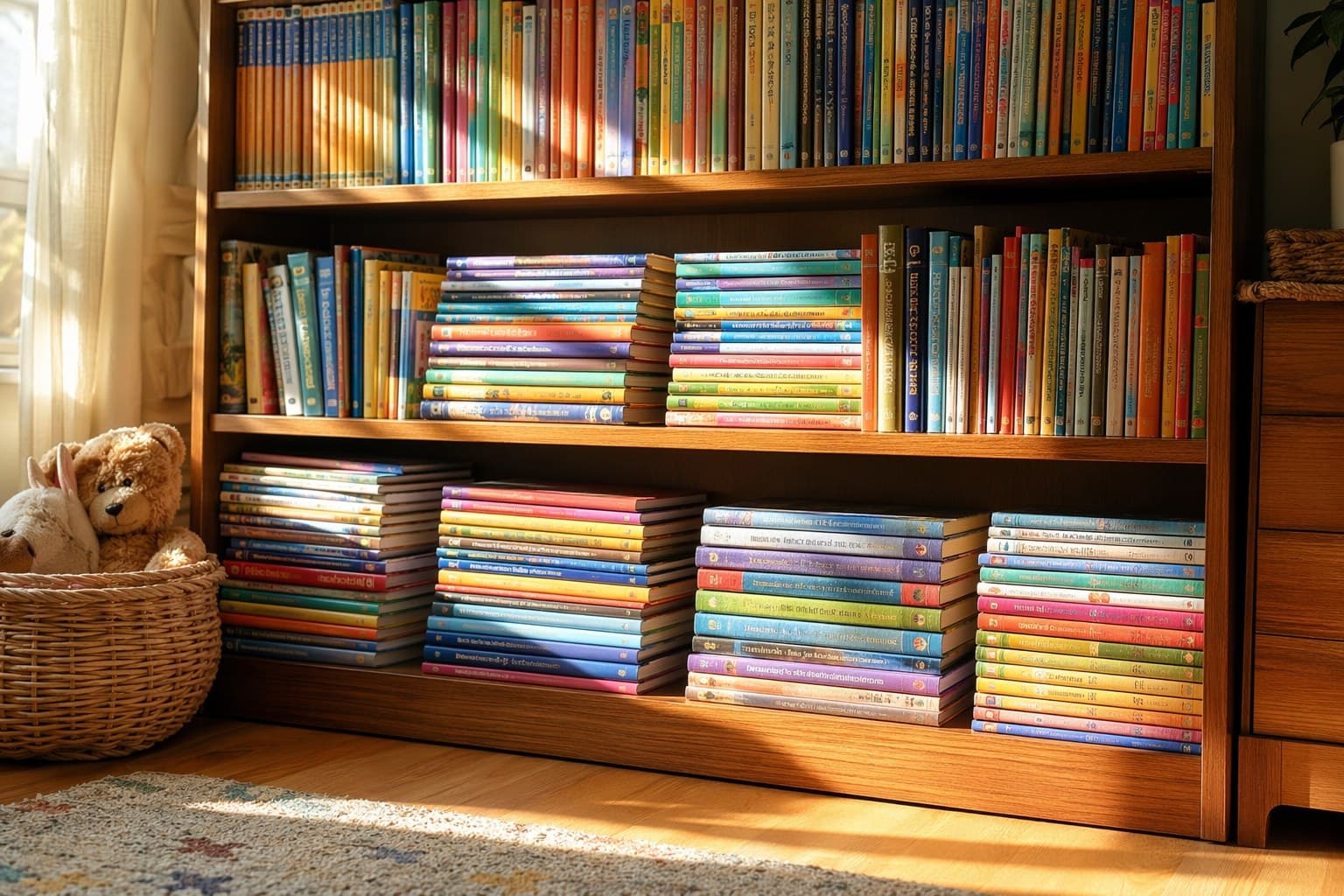
Walk into the bedroom of any child who loves to read and you will find the same thing: a shelf where one series has multiplied. Seven Magic Tree House books leaning against a stack of Boxcar Children. A complete set of Frog and Toad with the spines cracked white from rereading. The pattern is not an accident. Series are how children fall in love with reading, because a series removes the hardest part of choosing a book — deciding whether you will like it. Once a child trusts a world and a cast of characters, they will follow them happily through a dozen volumes, and every one of those volumes is fluency practice disguised as fun.
This is a guide to the best book series organized by reading level, from the chewable board books of babyhood to the doorstop fantasy epics that hook a ten-year-old for a whole summer. But it is more than a list. At each stage I will tell you what the series is doing for your child developmentally, what to read next when they finish, and how to use these books to build something bigger than any single title: a household where reading is simply what people do. We are a screen-free-leaning family, and books are the quiet engine that makes that possible. A child with a series they love does not ask for a tablet.
A quick word on "reading level." I am going to use rough age bands, but children do not read on a schedule. A four-year-old may be deep in early chapter books while a seven-year-old is still happily in picture-book land, and both are completely normal. Read the band above and below your child's age, ignore the numbers when they get in the way, and trust what you see when your child reads aloud. The reading curriculum you choose sets the mechanics; the series below supply the reason to use them.
How to Use This Guide (and the Five-Finger Rule)
Before the lists, one practical tool that will save you a hundred frustrating book selections. The five-finger rule: open a book to a middle page, have your child read it aloud, and put up one finger for every word they cannot read. Zero to one finger means the book is an easy, confidence-building read. Two to three fingers is the sweet spot — challenging enough to grow, easy enough to enjoy. Four or five fingers means it belongs in your read-aloud pile for now, not their independent stack.
Keep three piles going at all times: books your child reads alone, books you read aloud together (always a notch or two above their independent level), and audiobooks for the car and quiet time. A child who has all three running is getting a richer literary diet than any single approach delivers. Our guide to building a screen-free reading culture goes deep on the rhythms that keep all three piles full.

Ages 0 to 3: Board Books and the First Beloved Characters
At this age you are not teaching reading. You are teaching a child that a book is a warm place where a familiar voice and a familiar face show up every time. The "reading level" is your lap. Series matter here because repetition is everything — a baby who hears the same five board books three hundred times is laying down the neural grooves of language, rhythm, and story.
Start with the indestructible classics. The Indestructibles series is chew-proof, rip-proof, and washable, which matters more than any literary merit at eight months old. For real story, the Karen Katz lift-the-flap books turn reading into a game of peekaboo, and the fine-motor work of lifting a flap is genuine development. The towering classic of this age is Sandra Boynton's board books — Moo, Baa, La La La! and The Going to Bed Book are written with a musician's ear and beg to be read aloud with bounce.
What to read next: as your toddler nears three and can sit for a longer story, move toward the simple narrative picture books of the next band. The bridge title is anything by Eric Carle — The Very Hungry Caterpillar has the repetition of a board book but the arc of a real story.
Ages 3 to 5: Picture Book Series and Pre-Reading Power
Preschoolers cannot decode yet, but they can fall completely in love with characters, and picture book series give them recurring friends to come back to. This is also the age where pretend play and books feed each other beautifully — a child who loves a story will act it out, and the imaginative play that follows deepens comprehension far more than any worksheet.
The single best series for this age is Mo Willems' Elephant and Piggie books. Two characters, simple speech-bubble dialogue, and humor that genuinely lands — these are technically early readers, but they are the perfect read-aloud for a four-year-old and the first books many kids "read" by memory. For warmth and gentle adventure, the Llama Llama series by Anna Dewdney handles big toddler emotions — separation, frustration, bedtime — in rhyming text that soothes as it teaches. And no preschool shelf is complete without the Curious George collection, whose longer page count stretches a child's attention span toward the chapter books ahead.
What to read next: when your child starts asking "what does that word say?" and recognizing letters in the wild, they are ready for the controlled vocabulary of true early readers. That is the bridge into the next band, and it is one of the most exciting moments in a reader's life.
Ages 5 to 7: Early Readers — The Series That Build Fluency
This is the make-or-break stage, and series are your single best tool. Early readers use controlled, repeated vocabulary so a child experiences the thrill of reading a whole book themselves. The repetition across a series means each new book reinforces the words learned in the last. This is where a child crosses from "sounding out" to actually reading, and the right series makes that crossing feel like fun instead of work. If you are pairing this with formal instruction, see our breakdown of the best phonics programs — the books below are what makes the phonics worth doing.
The gold standard is Arnold Lobel's Frog and Toad — five-chapter books of such quiet perfection that adults reread them for pleasure. For laugh-out-loud humor that pulls reluctant readers in, Cynthia Rylant's Henry and Mudge and the same author's Mr. Putter and Tabby offer gentle, character-driven stories with a predictable structure that builds confidence. When a child wants to feel like they are reading a "real" book, Kate DiCamillo's Mercy Watson delivers full-color, slightly longer chapters about a toast-loving pig, with writing rhythmic enough to read aloud and accessible enough to read alone.
Here is the truth about this stage: let your child reread these endlessly. A fluent reread of a familiar Frog and Toad does more for developing fluency than struggling through something new. Volume and comfort matter more than novelty.
What to read next: once your child reads a Mercy Watson book in one sitting without exhaustion, they are ready for true chapter books — longer, with fewer pictures and a sustained plot across many chapters.
Ages 7 to 9: First Real Chapter Books — The Series Habit Forms
This is the age the series habit truly takes hold, and it is the most important reading window of childhood. A second or third grader who finds a series they love will read fifteen, twenty, thirty books in it — and that volume is exactly what builds reading stamina, vocabulary, and the unshakable identity of "I am a reader." Your job here is mostly to keep the supply flowing.
| Series | Reading challenge | Hooks the child who loves... | Approx. length |
|---|---|---|---|
| Magic Tree House | Gentle, lots of support | History, adventure, facts | 35+ books |
| The Boxcar Children | Simple, comforting | Mystery, self-reliance | 150+ books |
| Geronimo Stilton | Playful, visual text | Humor, silliness, illustration | 80+ books |
| Ivy and Bean | Realistic, dialogue-driven | Friendship, mischief | 12 books |
| The Princess in Black | Short, funny | Superhero twists, humor | 10+ books |
The engine of this age for most families is the Magic Tree House series by Mary Pope Osborne. Jack and Annie travel through time and place, and each fiction title pairs with a nonfiction "Fact Tracker," which makes the series a sneaky gateway into history and science. For comforting mystery with infinite volume, The Boxcar Children never runs out. And for the child who needs humor to stay engaged, Geronimo Stilton uses colorful, playful typography that actually supports reading by making key words pop off the page.
What to read next: when your child finishes a chapter book in a day or two and wants more pages and deeper plots, nudge them toward longer middle-grade series with multi-book arcs.

Ages 8 to 11: Middle-Grade Series — Worlds Worth Living In
Now the magic gets ambitious. Middle-grade series build entire worlds across many books, with character growth, real stakes, and themes that reward a thoughtful reader. This is where a child can disappear into a series for an entire summer — exactly the kind of deep, screen-free immersion we are building toward. A child reading the seventh book in a beloved series is doing something no app can replicate: sustaining attention, holding a complex world in mind, and choosing a book over a screen entirely on their own.
For fantasy that genuinely hooks, the Wings of Fire series by Tui Sutherland — dragons, prophecy, and political intrigue — is the series that converts countless reluctant readers. The Land of Stories by Chris Colfer reimagines fairy tales with real heart and length. For mythology-mad kids, the Percy Jackson series by Rick Riordan turns Greek mythology into a propulsive modern adventure and pairs beautifully with the kind of literature-based learning that treats great stories as the curriculum. And for graphic-novel lovers — a format that builds real visual literacy and is absolutely reading — Raina Telgemeier's books like Smile and Sisters speak directly to the social-emotional world of this age.
A note on graphic novels, because parents worry about them: they count. They build vocabulary, narrative comprehension, and the willingness to read for pleasure. A child who reads twenty graphic novels and then picks up Percy Jackson got there because the graphic novels kept them reading.
What to read next: the tween who finishes Percy Jackson is ready for the meatier classics and series that carry into the early teen years — longer, more morally complex, and often part of multi-trilogy universes.
The Asynchronous Reader: When Ability and Age Don't Match
Some children read far above their age, and this creates a genuine problem: a seven-year-old who decodes at a fifth-grade level is not emotionally ready for fifth-grade themes. The answer is never to hold a strong reader back — it is to broaden sideways instead of always pushing up. Lean on nonfiction series, which can be linguistically rich without mature content. Reach for classic series with gentler stakes, like the entire Little House run or the All-of-a-Kind Family books. And keep reading aloud above their level, where the challenge arrives safely from beside you.
The opposite case — the older child who is a slower or reluctant reader — is just as common and just as fine. High-interest, lower-difficulty series exist precisely for this: short chapters, lots of white space, humor, and momentum. Geronimo Stilton, Dog Man, and the I Survived series all carry a struggling fourth grader without making them feel babyish. The goal at every level is the same: keep them reading something they love. For more on supporting different learners, our guide to curriculum for learning differences goes deeper.

Building a Screen-Free Reading Culture Around Series
The books are only half of it. A child becomes a reader because of the environment around the books, and series are your secret weapon for building that environment. Here is what actually moves the needle.
Make the next book visible. The most powerful motivator is the half-finished series on the shelf. When book three is sitting right there after book two, the path forward is obvious. Buy or borrow ahead so there is never a gap.
Protect a daily reading rhythm. A consistent slot — after lunch, before bed — does more than any reward chart. Children who read at the same time every day stop treating it as an assignment and start treating it as part of the day, the way our daily schedule guide builds reading into the natural flow rather than bolting it on.
Let them choose. A series a child picks themselves will be read; one you assign will be endured. Your job is to stock the shelf and step back. The summer is the ideal proving ground — our summer reading culture guide shows how a few months with the right series can turn a kid into a lifelong reader, while a screen-free birthday party and book-themed gifts keep books woven into the celebrations of childhood, not just its schoolwork.
Keep reading aloud, forever. Even when your child reads independently, the shared experience of a great series read aloud is irreplaceable. The best read-aloud books by grade gives you a full progression for exactly this.
Frequently Asked Questions
Are audiobooks "cheating" or do they count as reading? They count, and they are wonderful — with one nuance. Audiobooks build vocabulary, comprehension, listening stamina, and love of story, and they let a child enjoy books above their decoding level. What they do not build is the decoding skill itself, which only comes from eyes on print. So use audiobooks generously as a supplement and a joy — perfect for the car, chores, and rest time — but keep print in the daily rhythm too. The ideal is a child who listens to a series above their level while reading another series at their level.
How many books should my child be reading? There is no magic number, and chasing a count can backfire by turning reading into a competition. Focus on consistency over quantity: a child who reads twenty minutes every day, year after year, becomes a far stronger reader than one who binges for a weekend and then stops for a month. That said, a child who has found the right series often reads far more than any goal would set — which is exactly the point of choosing books they love.
What if my child only wants to read one type of book — only graphic novels, only dragons, only nonfiction? Let them, and relax. A "narrow" reader is still a reader, and the volume of reading within a beloved genre builds all the same skills. Over time, gently leave other series within reach — a fantasy lover might pick up a mythology series, a nonfiction kid might try historical fiction — but never make the new genre a condition. The reading habit is the prize. Breadth tends to follow naturally once a child is confident and hooked.
The Long View
Reading levels are a useful map, not a destination. The numbered bands in this guide will matter for a few short years, and then they will dissolve entirely into a person who simply reads — for pleasure, for knowledge, for the company of a good story on a quiet afternoon. That person is built one series at a time, on a shelf where the next book is always waiting.
So stock the shelf. Read aloud past their level and let them reread below it. Say yes to the dragons and the graphic novels and the eightieth Boxcar Children mystery. Protect the daily reading hour the way you would protect a meal. The series will change as your child grows — from chewed board books to summer-long epics — but the habit of disappearing into a book is the one that lasts a lifetime, and it is, quietly, the best screen-free gift you can give.
Frequently Asked Questions
- How do I know what reading level my child is actually at?
- Forget grade-equivalent numbers for a moment and watch how your child reads aloud. If they read a page smoothly with no more than a handful of stumbles and can tell you what happened, that book is at their independent level. If they miss roughly one word in twenty and need help to follow the plot, it is an instructional or read-aloud level. The simplest at-home test is the five-finger rule: have your child read one page and put up a finger for each word they cannot read. Zero or one finger is easy, two or three is just right, and four or five means save it as a read-aloud for now.
- Should I let my child reread the same series over and over?
- Yes, and you should celebrate it. Rereading is one of the most powerful things a developing reader can do. Familiar books let a child read faster and more fluently, deepen comprehension, notice details they missed, and absorb sentence patterns and vocabulary without the cognitive load of decoding everything new. A child who has read the entire Magic Tree House series four times is not stuck — they are building the fluency and confidence that makes harder books possible later.
- My child can read above their age but the content feels too mature. What do I do?
- This is the classic 'asynchronous reader' challenge, and it is very common. Reading ability often outpaces emotional readiness, so a seven-year-old who decodes at a fifth-grade level may not be ready for the themes in a fifth-grade novel. The solution is to choose by interest and emotional fit, not just difficulty. Look for series that are linguistically rich but age-appropriate in content, lean on nonfiction and classic series with gentler stakes, and keep reading aloud books slightly above their independent level so the challenge comes from a safe place beside you.
Enjoying this article?
Get more ideas like this delivered to your inbox every week.