Best Marble Run Sets for Kids (STEM Building Toys That Actually Last)
The best marble runs for kids of every age — from chunky toddler-safe sets to advanced engineering kits. A comparison of Hape, Quadrilla, HABA, and more.
By The Slow Childhood
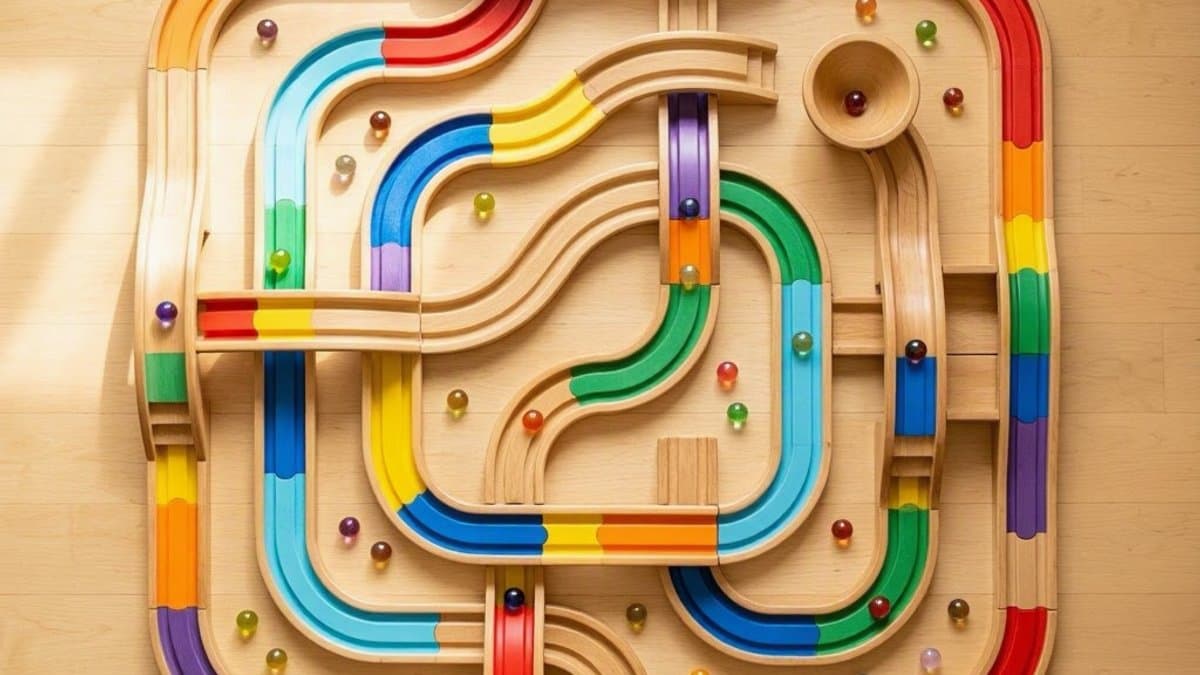
A marble run is one of the rare toys that combines pure aesthetic pleasure (watching a marble roll down a clever track), real engineering learning (testing hypotheses about how things work), and extended open-ended play (building, rebuilding, improving, sharing). The satisfaction of a successful run — marble released at the top, racing through curves and drops, finally plinking into the catch — is universal. Children watch it five times, ten times, then immediately rebuild.
But marble run quality varies dramatically. A cheap plastic set with warped pieces and unclear connections becomes a source of frustration. A quality set invites hours of focused engineering play. This guide covers the marble runs we actually recommend, organized by age and approach.
Best Wooden Marble Runs
Wooden marble runs have a timeless quality that plastic sets cannot match. They feel good, age beautifully, and often serve multiple siblings over a decade.
Hape Quadrilla
Hape Quadrilla is our top wooden marble run pick. The system uses solid wooden blocks with drilled channels, creating a beautiful, heirloom-quality toy. The genius of Quadrilla is that different colored blocks have different internal channels (straight-through, diverting, counting, etc.), which become discoverable puzzles for children to solve.
Pros:
- Beautiful solid wood construction that ages well
- The color-coded block system teaches cause-and-effect brilliantly
- Durable for multiple children across many years
- Expansion packs allow the system to grow
- Holds resale value exceptionally well
- Does not look like junk in your living room
Cons:
- Expensive ($100+ for basic starter sets, expansions add up)
- Fewer feature variations than plastic alternatives
- Requires flat surface for reliable operation
Starter set: Quadrilla Basic Set (about $100) includes 70 pieces and is the ideal introduction. Best for: Families wanting a beautiful, educational, heirloom-quality marble run.
HABA Ball Track Basic Building Box
HABA Ball Track is a classic German wooden marble run system. The pieces are beautifully crafted with attention to detail, and the system emphasizes open-ended building over specific feature tracks.
Pros:
- Traditional German craftsmanship
- Beautiful solid beech wood
- Open-ended design encourages creativity
- Compatible across HABA's extensive ball track line
- Ages 3-10 depending on supervision
Cons:
- Expensive for the piece count
- Less exciting "features" than some plastic alternatives
- Ball size requires care with younger children
Best for: Waldorf-inspired families or those wanting high-quality traditional construction.
Melissa & Doug Wooden Marble Maze
The Melissa & Doug Wooden Marble Maze is a more affordable wooden option that provides a good introduction to the concept. It is a fixed maze rather than a buildable system, but works well for ages 3-5 before stepping up to a building system.
Best for: First marble experience for younger children.
Best Plastic Marble Runs
Plastic marble runs tend to have more creative features, more tracks, and more exciting engineering elements than wooden sets. If you care more about engineering challenges than aesthetics, plastic is often the better choice.
Marble Genius Marble Run
Marble Genius Marble Run is one of the most popular plastic marble runs. The system includes translucent tracks, funnels, loops, and various creative elements. Connections are secure, and the pieces are compatible with extension sets.
Pros:
- Affordable (around $40 for 100-piece set)
- Translucent tracks let children watch marbles travel
- Good variety of creative elements
- Widely available
- Fun color palette
Cons:
- Plastic aesthetic
- Connections can be fiddly initially
- Some pieces are prone to breaking under heavy use
Best for: Budget-conscious families wanting a lot of play variety at a reasonable price.
Marble Run Super Set 60/85/120 pieces
Marble Run Super Sets offer similar value to Marble Genius at comparable price points. Multiple sub-brands offer very similar products — Marble Genius has the strongest reputation, but many alternatives work fine.
Best for: Alternative to Marble Genius if you find it out of stock or prefer a specific color palette.
Best Advanced Marble Run: GraviTrax
GraviTrax deserves its own category because it is not really a traditional marble run — it is a gravity-based engineering system by Ravensburger. GraviTrax includes magnets, gauss cannons, flip elements, loops, and complex track systems that teach real physics concepts.
Pros:
- Genuinely challenging and educational for older kids
- Includes physics elements (magnets, momentum, gravity) that traditional marble runs lack
- Expandable with dozens of add-on packs
- Can be combined with the Ravensburger app for coding challenges
- Engages children for years, not weeks
- Excellent for STEM learning
Cons:
- More expensive than traditional marble runs (starter set is $50-70, comprehensive collection reaches hundreds)
- Age 8+ minimum to really appreciate the features
- Small parts require careful organization
- Some elements are delicate
Starter set: GraviTrax Starter Set is the entry point. Best for: Children ages 8+ interested in engineering, physics, and complex systems.
GraviTrax Pro
GraviTrax Pro is the upgraded system with 3D building capabilities. Children build multi-level structures rather than 2D track layouts. Significantly more advanced but also more impressive.
Best for: Ages 10+ who have mastered the basic GraviTrax system.
Toddler-Safe Ball Runs
For children under 3, traditional marble runs are a choking hazard. These alternatives provide the same cause-and-effect fun with larger, safer balls.
Hape Quadrilla The Cyclone (Younger Age Variant)
Some Hape ball track sets use larger wooden balls safe for ages 3+. The Quadrilla The Cyclone is one of these.
Best for: Young children wanting a Quadrilla experience safely.
Melissa & Doug First Bead Maze
For very young children (12+ months), a bead maze (like the Melissa & Doug First Bead Maze) offers a similar cause-and-effect experience with no choking risk.
Best for: 12-24 month old children.
Lovevery Threadable Bead Kit
The Lovevery Threadable Bead Kit (part of Lovevery subscription) is a fantastic large-ball run for toddlers ages 12+ months with focus on fine motor skills and cause-and-effect.
Best for: Toddlers developing fine motor skills.
Marble Run Accessories and Extensions
Marbles
Most marble runs include some marbles, but many families want more. Quality glass marbles are beautiful and roll well. Size matters — check your marble run's required marble size (usually 14mm or 16mm).
Marble Catcher / Tray
A marble catcher tray at the base of the marble run prevents marbles from rolling across the floor. Simple but transformative for everyday use.
Storage Bins
Clear storage bins make organizing marble run pieces dramatically easier. Children can find the piece they need and clean up efficiently.
What to Skip
Magnetic marble runs with weak magnets. Marble runs that claim to be magnetic but use weak magnets frequently collapse during play. The frustration is not worth the novelty.
Unbranded cheap plastic sets. The Amazon and Dollar Tree category of "marble run" sets that cost under $15 are often disappointing — pieces do not connect reliably, the plastic cracks, and the marbles get stuck. Spend at least $30-40 for the cheapest acceptable set.
Marble runs with tiny pieces for young children. The small coupling pieces in some advanced sets frustrate children under 6. Match complexity to developmental readiness.
Growing a Marble Run Collection
Start with a solid mid-range starter set. 50-100 pieces is the right starting point. Too few pieces means children quickly hit the limits of what they can build; too many pieces at once overwhelms younger children.
Add expansions annually. Birthday and Christmas are ideal times for marble run expansion packs. Children who receive pieces over time learn to integrate new elements into existing builds.
Keep the set accessible. Marble runs that live in a closet get used rarely. A dedicated bin on a low shelf where children can retrieve and return the pieces themselves keeps the toy in rotation.
Expect repeated builds of similar designs. Children often rebuild the same or similar designs many times. This is how they master the system — each build reveals something new. Resist the urge to push them toward novelty; repetition is the work.
For more on building toys and STEM play, see our guides to best magnetic tiles, best LEGO sets by age, and STEM activities for preschoolers.
A marble run belongs in the same category of toys as LEGO and magnetic tiles — not a single-purpose toy but a creative medium that grows with a child. Invest in quality, add to the collection over time, and watch the hours of focused, engaged play unfold.
Frequently Asked Questions
- What age is a marble run appropriate for?
- Marble runs are appropriate for ages 3+ due to small parts (the marbles themselves are a choking hazard). For younger children, several brands make toddler-safe marble runs that use large balls instead of marbles (like Hape's Quadrilla The Cyclone for ages 4+, or chunky plastic ball runs for ages 1-3). Standard marble runs with actual marbles work best for children ages 4+, with older children (7+) able to build the most complex structures.
- Wooden or plastic marble run?
- Wooden marble runs last longer, feel higher quality, and age better — they become heirlooms that pass through siblings. Plastic marble runs typically have more creative features, tracks, and engineering elements at a similar or lower price point. The choice often comes down to aesthetic preference and budget: wooden (like HABA or Hape Quadrilla) for timeless, heirloom quality; plastic (like Marble Genius or GraviTrax) for maximum variety of features.
- How many pieces do you need for a good marble run?
- A starter marble run with 30-50 pieces is enough for basic tracks. A really engaging marble run that invites deep play and complex builds usually needs 70-150 pieces. Premium systems like GraviTrax and Quadrilla are designed to be expanded over time — start with a 60-100 piece starter set and add expansion packs as your child's ambitions grow. For gifts across multiple holidays, marble run expansion packs are excellent add-ons.
- Is GraviTrax better than traditional marble runs?
- GraviTrax is a different category — it's a modular marble run system with genuine physics-based elements (magnets, cannons, free-fall sections, loops). It's better for ages 8+ children interested in engineering, physics, and systems thinking. Traditional marble runs (wooden or plastic) are better for ages 3-8 focused on building, experimentation, and simple cause-and-effect. Many families eventually own both types.
Enjoying this article?
Get more ideas like this delivered to your inbox every week.