Chore Charts That Actually Work: Balancing Responsibility and Freedom
A chore chart should build competence, not turn your kitchen into a points economy. Here is how to design an age-appropriate responsibility system that motivates kids without bribing or punishing — with real setups, supplies, and a template that grows with your family.
By The Slow Childhood
We tried our first chore chart when our oldest was four, and it failed in a way that still makes me wince. It was a glittery sticker chart from the craft store with a "prize box" at the end of every full week. Within a month she was negotiating — "How many stickers for picking up the blocks?" — and our three-year-old had figured out that crying loudly was a faster route to the prize box than actually doing anything. We had accidentally built a tiny, dysfunctional economy on our refrigerator, and the thing it was producing was not responsibility. It was bargaining.
So we threw it out and started over, this time asking a different question. Not "how do we get the kids to do chores?" but "how do we help them feel like genuine, capable contributors to this household?" That shift changed everything about how we design our chore chart and responsibility system — and it is the heart of everything that follows.
Why Chores Are About Competence, Not Compliance
The research that reshaped our thinking comes out of a long-running study at the University of Minnesota, which found that the single best childhood predictor of young-adult success — measured as finishing school, getting established in a career, and maintaining relationships — was whether a child had begun doing chores at an early age. Not test scores. Not enrichment classes. Chores.
The reason makes intuitive sense once you sit with it. When a child is genuinely responsible for something the family depends on — the dog actually gets fed, the table actually gets set — they absorb a quiet, foundational message: I am capable, and what I do matters to the people I love. That is the seed of competence and of contribution, and you cannot buy it with stickers or extract it with threats.
This is the same instinct Maria Montessori built her "practical life" curriculum around more than a century ago. Real work, scaled to the child, is one of the most respectful things we can offer them. If you want to go deeper on which tasks suit which stage, our guide to Montessori practical life activities by age maps it out in detail, and our breakdown of age-appropriate chores for kids gives you a room-by-room starting list.
A chart, then, is not a behavior-management tool. It is a visible record of belonging. Hold onto that distinction, because it determines every design choice you are about to make.
The Reward Trap: Why Over-Rewarding Backfires
Here is the part that surprises people. Decades of motivation research — most famously work by Edward Deci and Richard Ryan — shows that paying or prizing children for tasks they would otherwise do for their own reasons can actually reduce their willingness to do them. Psychologists call it the overjustification effect. Once a reward becomes the reason, the activity loses its own value, and the day you stop paying is the day the work stops.
We watched this happen on our glittery sticker chart in real time. The stickers became the point. The contribution evaporated.
That does not mean acknowledgment is bad — kids thrive on it. The trick is the kind of acknowledgment. Compare these two:
- "Here is your dollar for emptying the dishwasher." (transactional — trains the child to ask the price)
- "The kitchen looks so much better with that done. Thank you for handling it." (relational — reinforces the child's competence and place in the family)
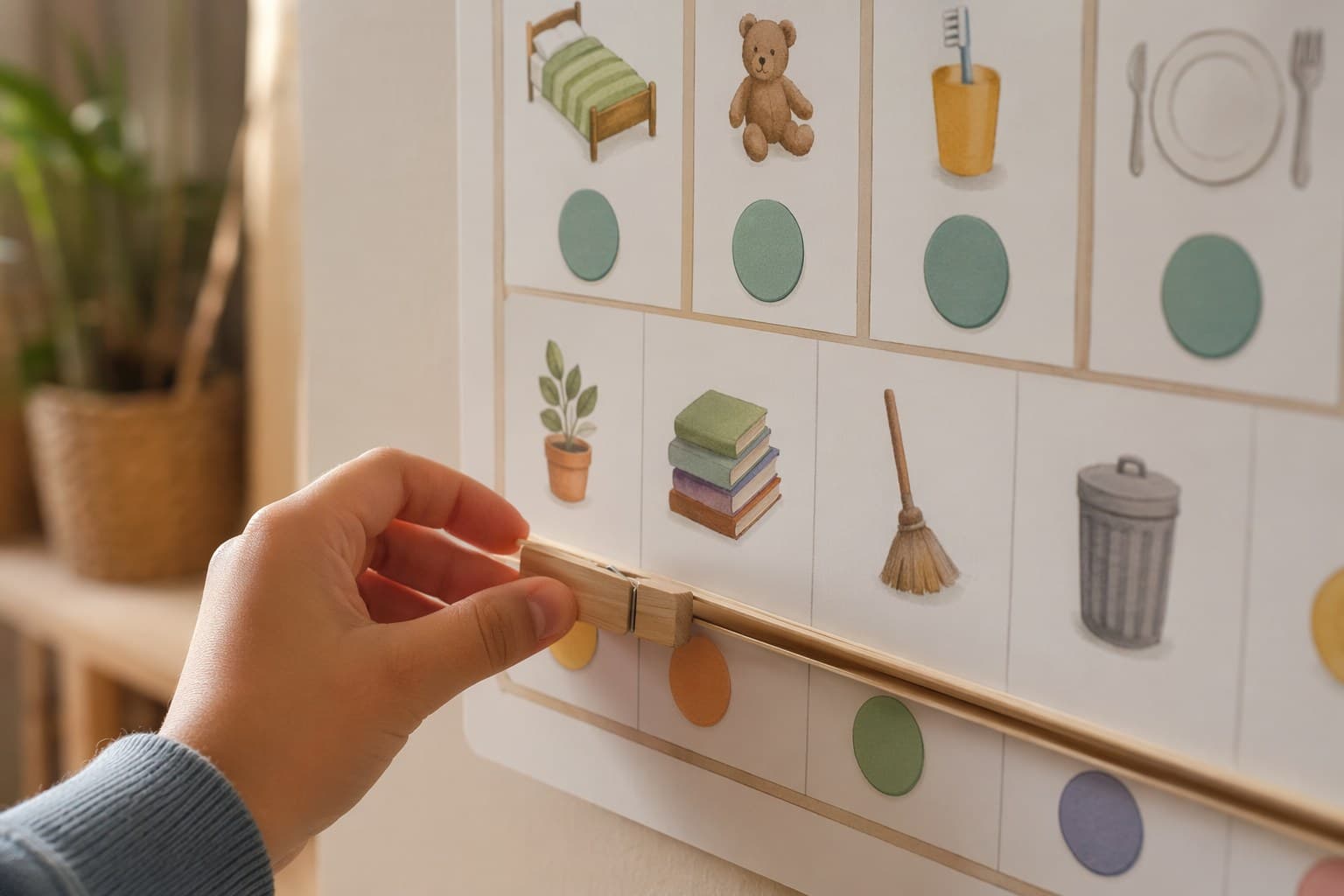
The second costs nothing and builds exactly what you want. So in our house, the chart tracks completion for the child's own sense of progress, not to bank points toward a payout. We use a simple magnetic clip reward system where the child slides a clip from "to do" to "done" — and the satisfying click of moving it is genuinely most of the reward for a five-year-old. The visible "all done" column is the prize.
If you do want to teach money skills, keep that channel completely separate from the baseline chores. A small fixed allowance, or genuinely optional "extra jobs" priced individually, sits outside the chart. The everyday work of running a shared home is never for sale.
Designing a Chart That Actually Gets Used
The best chore chart is the one your child can operate without you. That means it has to be visual, durable, and dead simple. Here is what has survived years of real use in our kitchen.
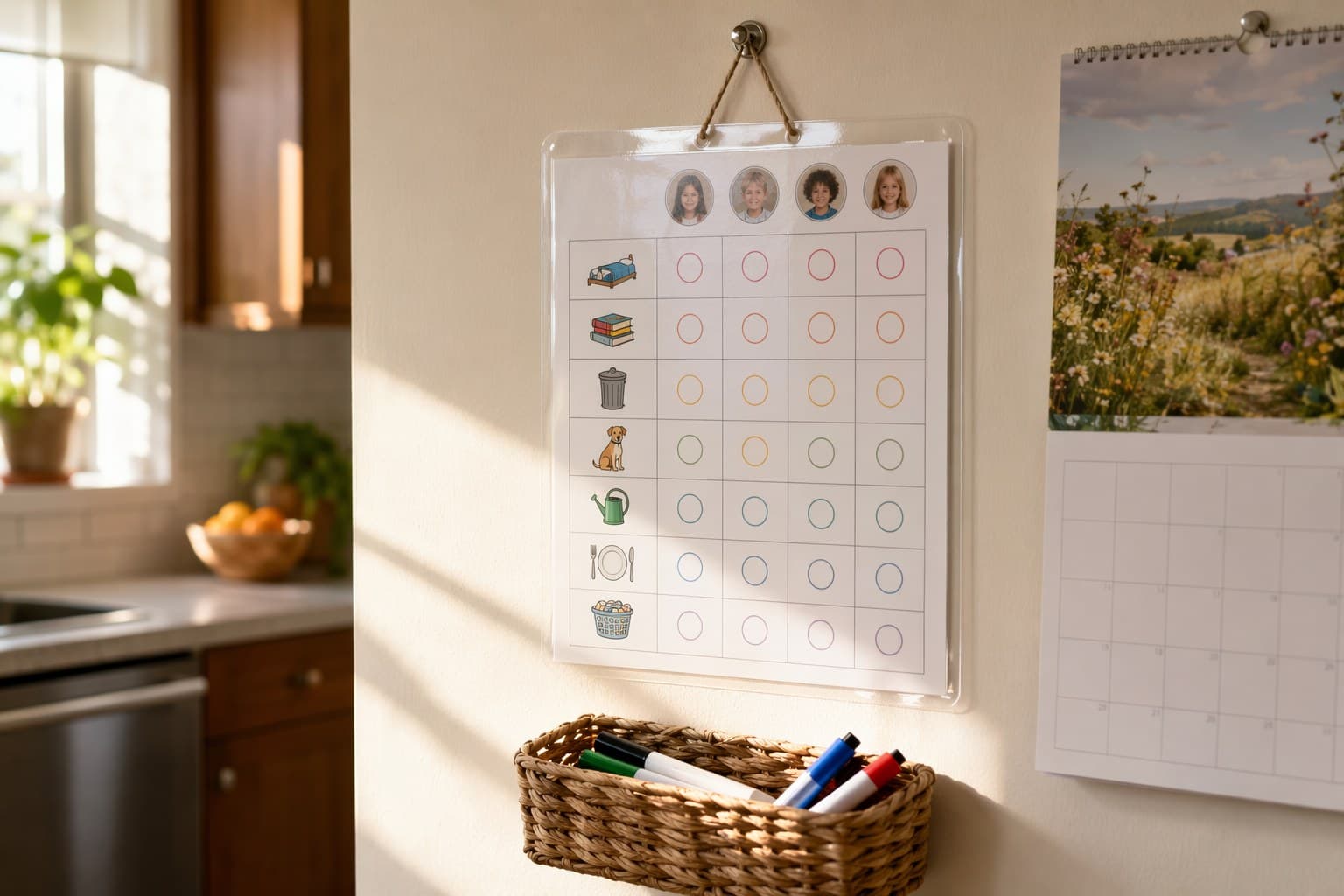
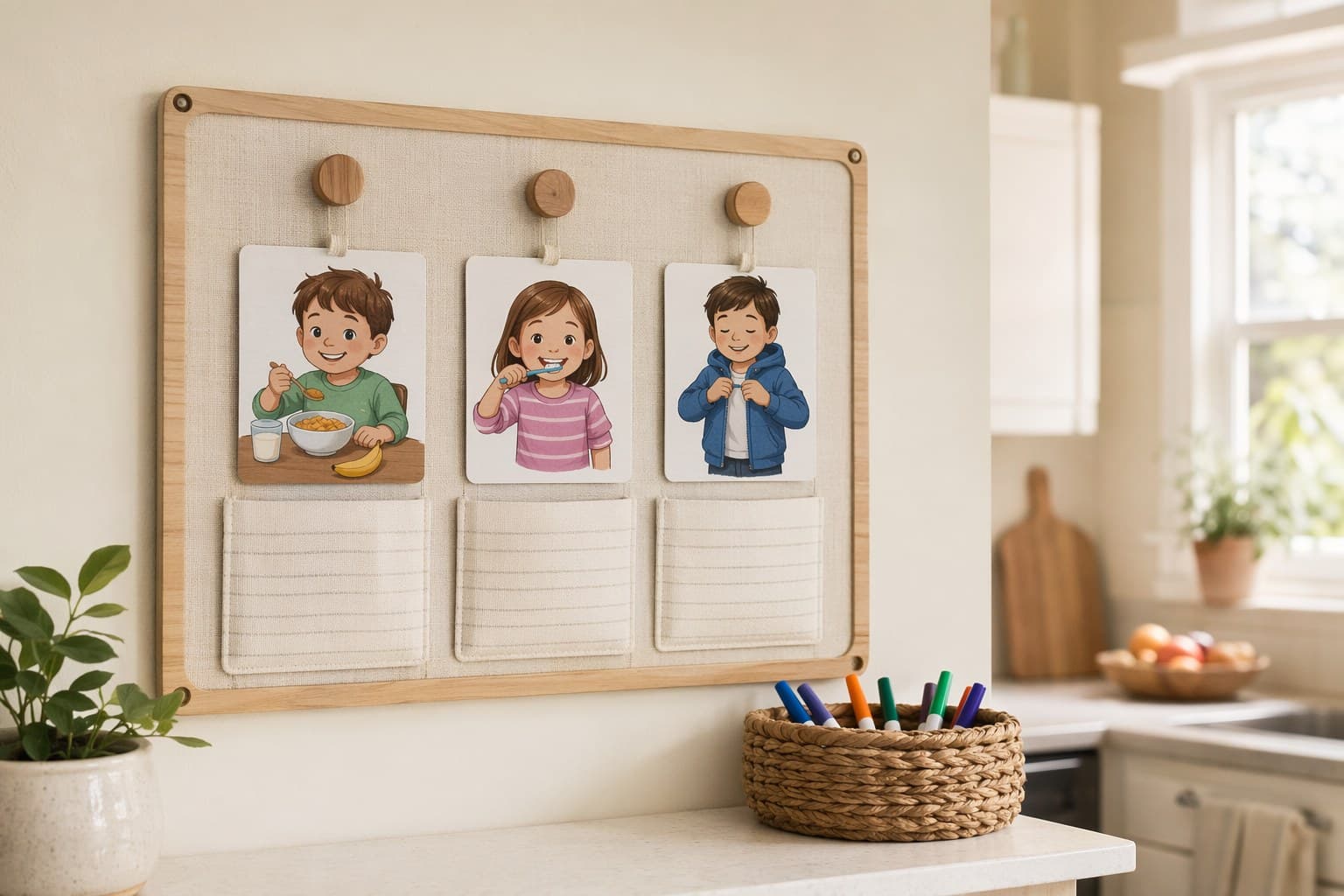
Make it reusable. Paper charts get crumpled, lost, and rewritten weekly until you quietly give up. A laminated reusable chore chart paired with a fine-tip dry erase marker set means you wipe it clean each morning and you are done. We keep the markers in a little basket beside the chart so they never wander.
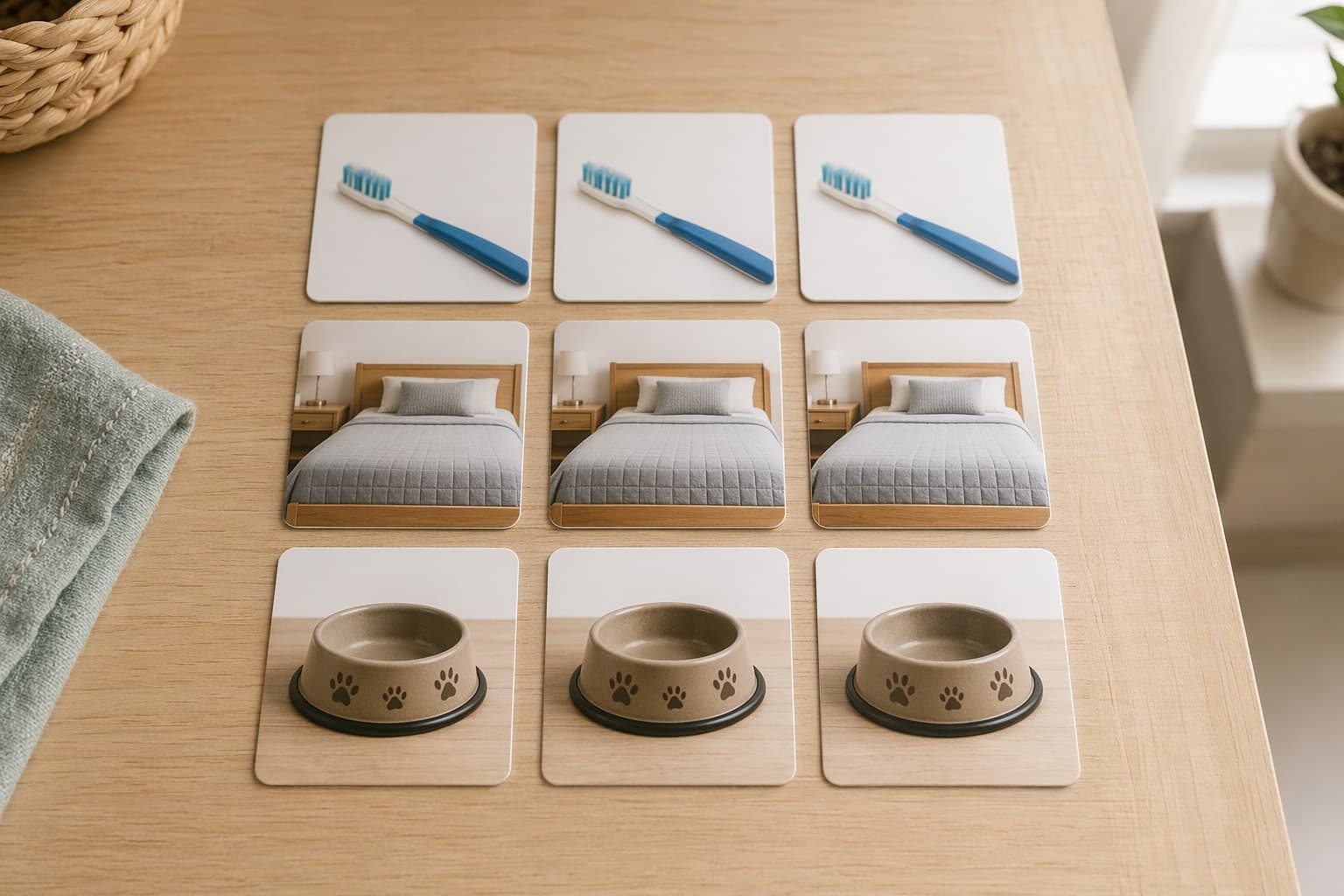
Make it readable before they can read. For pre-readers, words are useless. We use visual schedule picture cards — a little image of a toothbrush, a made bed, a dog dish — so a three-year-old can run the whole sequence independently. This single change cut our morning nagging roughly in half. A set of swappable chore task cards lets you rotate responsibilities without rebuilding the chart, which matters more than you would expect once you have more than one child trading jobs.
Keep the list short. Three to five tasks per child, maximum. A chart with fourteen items is a chart nobody finishes, and an unfinished chart teaches kids that the chart does not really mean anything. We would rather have three chores done reliably than ten done resentfully.
Anchor chores to the day's rhythm. Tie each task to something that already happens — after breakfast we make beds, before screen time we tidy the room, before dinner we set the table. This is the same logic behind a predictable daily flow, and it is why a chore system slots so naturally into a homeschool daily schedule and routine. When the chore is welded to an anchor, you stop being the reminder and the routine carries the load.
A Sample System That Grows With the Child
Here is the actual structure we run, lightly adapted by age. Treat it as a starting frame, not gospel.
Ages 2 to 4 (alongside you): Put toys in the bin. Carry your plate to the counter. Hand laundry into the basket. These are done with a parent, narrated cheerfully, every single time. The chart at this age is mostly pictures, and the win is participation, not perfection.
Ages 5 to 7 (with a check-in): Make the bed. Feed the pet. Set or clear the table. Tidy the bedroom floor before bed. The child runs the chart independently and you spot-check, resisting the urge to redo a lumpy bed in front of them. A made bed made by a six-year-old is a success, full stop.
Ages 8 to 11 (largely independent): Manage one full chore zone — say, the bathroom sink and mirror — plus a rotating dinner-related job. Start a load of laundry from start to finish. Around now we fold the daily chart into a weekly one, because they can hold more in their heads.
Ages 12 and up (ownership): Own outcomes, not just tasks. "The kitchen is clean after dinner on your nights" replaces a checklist of sub-steps. The chart becomes a shared family board rather than a child-management tool.
The thread running through all of it: the chart hands more responsibility and more autonomy over time. That is the freedom half of the balance. Responsibility without growing freedom feels like a sentence; freedom without responsibility feels like neglect. The chart is where you hold the two in tension, and you loosen your grip a little every year.
When It Stops Working (Because It Will)
Some weeks the whole system goes slack. A kid hits a wall on bed-making, the toddler regresses, everyone is tired. This is normal, and it is not a sign your system is broken — it is a sign your kids are human.
When that happens, we resist two temptations: piling on consequences, and quietly doing it all ourselves to keep the peace. Instead we shrink the chart. Drop back to one or two non-negotiable tasks, get those solid again, and rebuild. We also reset the chart with the kids every so often — sitting down together to swap who does what keeps it from feeling like something imposed on them and turns it back into something they help run.
And we keep our own standards honest. A six-year-old's swept floor will have crumbs in the corners. If we re-sweep it in front of her, the message lands instantly: your work doesn't count. Far better to let the imperfect job stand, thank her for it, and let competence build at its own pace.
The Quiet Goal Behind the Chart
A chore chart, done well, eventually makes itself obsolete. The point was never the laminated grid on the wall. The point is a child who, at fourteen, notices the trash is full and takes it out without being asked — not because there is a dollar in it, and not because they will get in trouble, but because they live here, and that is simply what people who belong to a place do.
That is the whole project: capable kids who feel the satisfaction of contributing. The chart is just the scaffolding we use to get there, and the best sign it is working is the day you realize you have not looked at it in a week, because nobody needs to anymore.
Frequently Asked Questions
- Should I pay my kids for chores?
- Our short answer is no, not for the everyday work of keeping a shared home running. Making your bed, clearing your plate, and feeding the dog are part of belonging to a family, not a transaction. When every task carries a price tag, children learn to ask 'what do I get?' before they will lift a finger, and the intrinsic satisfaction of contributing quietly disappears. If you want to teach money management, keep it separate — give a small regular allowance tied to age rather than performance, or offer paid 'extra jobs' (washing the car, weeding the garden) that sit clearly outside the baseline expectations on the chart.
- What age can kids start doing chores?
- Earlier than most parents think. Toddlers as young as 18 months to 2 years can carry their dish to the counter, put toys in a bin, and hand you laundry from the dryer. By 3 to 4, children can set napkins, water plants, and match socks. By 5 to 7 they can make a bed (imperfectly), feed pets, and clear the table. By 8 and up, kids can handle laundry start to finish, sweep, and prep simple food. The key is matching the task to the child and accepting that 'done by a six-year-old' looks different from 'done by you.'
- How do I get my kids to do chores without nagging?
- Make the system, not your voice, the thing that holds the expectation. A visual chart they can read at a glance removes you from the role of human reminder. Tie chores to anchor points in the day — after breakfast, before screen time, before dinner — so they become automatic rather than negotiated each time. Do the work alongside young children for as long as they need a partner, narrate it cheerfully, and resist redoing their efforts in front of them. Most nagging comes from a system that lives in the parent's head; move it onto the wall and the nagging largely stops.
Enjoying this article?
Get more ideas like this delivered to your inbox every week.